
On the 23rd of June 2026, PubAffairs Bruxelles organised an afternoon of discussion on whether the European Union can deliver on its climate objectives while sustaining a competitive, innovative and resilient industrial base. The event was also a timely opportunity to discuss the implementation of the EU Emissions Trading System (ETS) and the entry to force of the Carbon Border Adjustment Mechanism (CBAM), as well as their implications on the competitiveness of the European industry, with the distinguished speakers Tom Howes, Adviser, Green Transition and Market Regulation, European Commission; Bruno Tobback MEP (S&D/BE), ITRE Member; Michael Bloss MEP (Greens/DE), ENVI Member; Radan Kanev MEP (EPP/BG), ENVI Member and Klaus Hofstadler, Head of Energy and Operation Optimisation, LAT Nitrogen. Leo Alders, Chief Executive Officer of LAT Nitrogen, gave a keynote speech, while Antoine Hoxha, Director General, Fertilizers Europe, gave the closing statements.
The discussion was moderated by Kait Bolongaro, Managing Editor at MLex.
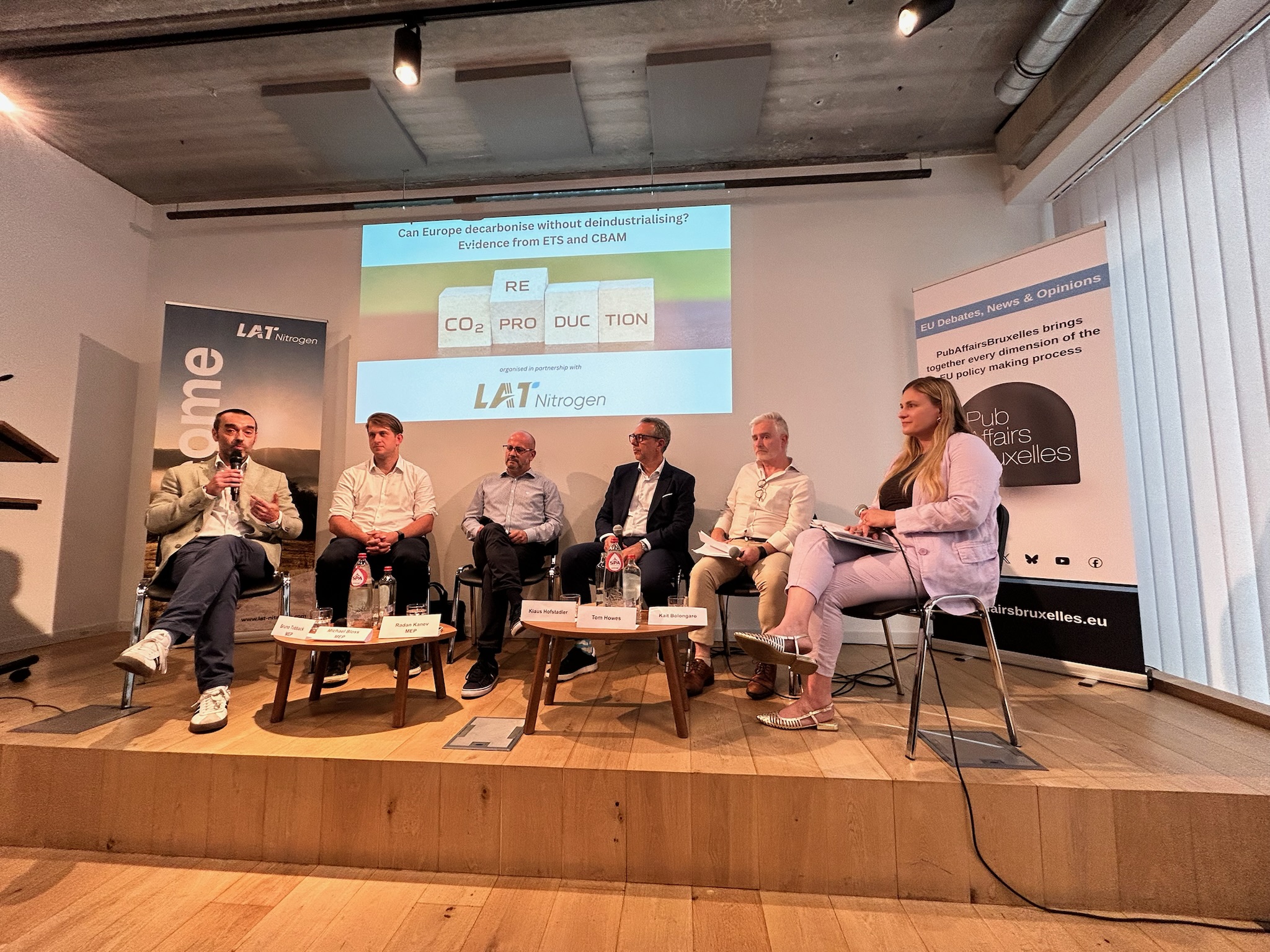
The moderator opened the debate by welcoming the audience and introducing the central question of the discussion, namely whether the European Union can deliver on its climate objectives while sustaining a competitive, innovative and resilient industrial base. She then introduced Leo Alders, CEO of LAT Nitrogen, and invited him to deliver his keynote address.
Leo Alders began by thanking the audience for attending and expressing his appreciation to the panellists for participating in what he described as a timely discussion.
He went on to argue that the challenges under discussion could not be addressed by any single institution, political family or industry acting alone. He emphasised the importance of dialogue and cooperation among all stakeholders, noting that the public debate is shifting from the need to decarbonise towards the challenge of achieving decarbonisation whilst ensuring that Europe remains an industrial powerhouse.
Mr Alders continued by arguing that Europe cannot be climate-neutral if it is no longer an important industrial player, and that this is precisely why the discussion is so important. He explained that the debate centred on two instruments designed to function together: the EU Emissions Trading System (ETS) and the Carbon Border Adjustment Mechanism (CBAM). The former, he noted, was established to put a price on carbon, while the latter was designed to safeguard that carbon price by preventing carbon leakage. As CBAM enters its final implementation phase and discussions continue on the future of the ETS, he argued that this is the right moment to consider how to create the conditions necessary to stimulate investment.
Mr Alders noted that engaging in this discussion is both encouraging and challenging. It is encouraging, he explained, because the industry has demonstrated that carbon pricing can work. As an example, he highlighted that LAT Nitrogen has significantly reduced its emissions, invested in innovation and improved its operational efficiency, thereby demonstrating that industry can respond positively to ambitious climate policies. At the same time, he stressed that carbon pricing alone cannot deliver industrial decarbonisation. Rather, industry needs confidence and support: confidence that the regulatory framework will remain predictable and that clean energy will be available at competitive prices, and support for those companies that invest and innovate rather than relying on the status quo.
Mr Alders then turned to what he described as the central issue: Europe must preserve domestic fertiliser production in order to strengthen food security and strategic resilience while also achieving its climate ambitions. He argued that this, in turn, requires a CBAM that delivers a genuinely level playing field and an ETS that drives decarbonisation without pricing investment out of Europe.
He therefore called for an industrial policy that recognises a fundamental reality: competitiveness and decarbonisation are not competing objectives but mutually reinforcing ones. Should Europe lose its industrial base, he warned, it would also lose one of its strongest allies in delivering climate neutrality. He concluded by stating that the debate should not be about choosing between sustainability and competitiveness, but about ensuring that the European Union succeeds in achieving both.
Kait Bolongaro thanked Leo Alders for his keynote address, noting that it has encapsulated some of the fundamental underpinning issues the panel would subsequently explore. She then observed that, for several years, Europe’s climate debate had centred on setting targets and developing legislation. Today, however, the discussion is shifting towards an era of omnibus proposals and regulatory simplification, as the European Commission seeks to balance its objective of maintaining Europe’s global competitiveness amid heightened geopolitical tensions whilst continuing to deliver on its climate ambitions.
She then introduced the panellists and opened the discussion by inviting Tom Howes to share the European Commission’s perspective. In particular, she asked what he considered to have been the greatest challenge in ensuring that the EU Emissions Trading System (ETS) and the Carbon Border Adjustment Mechanism (CBAM) function as intended.
Tom Howes replied that the European framework has been in place for a number of years, providing a long-standing and relatively stable vision of where Europe, as a decarbonised-but-industrial economy, is expected to be over the coming decades. He argued that this vision has remained clear for more than twenty years and explained that it has been reinforced in recent years through more immediate targets, supporting policies, accompanying measures and dedicated funding designed to facilitate their implementation.
Mr Howes noted that this framework of progressively increasing decarbonisation operates against the backdrop of an energy market in which Europe has never enjoyed a comparative advantage, with energy prices remaining approximately twice as high as those in the United States. He recalled that Europe had already begun addressing this structural challenge more than fifty years ago, following the first oil crisis in 1973, when the European Commission published its first policy papers on achieving greater energy independence and reducing reliance on imported fossil fuels. Since then, he observed, Europe has become one of the world’s most energy-efficient economies in general, and across its buildings, transport and industrial sectors, in particular.
He explained that the objective of making decarbonisation affordable while preserving Europe’s industrial base had been embedded in the design of the EU Emissions Trading System (ETS) from the outset and has subsequently been complemented by the Carbon Border Adjustment Mechanism (CBAM). He recalled that the ETS initially operated with relatively low carbon prices and a system of free allowances.
These allowances, he noted, are being gradually phased out in recognition of the fact that international competitors do not operate under the same carbon pricing framework as the European industry. CBAM, he explained, represents the latest attempt to create a more level playing field by requiring imports into the European Union to bear a carbon cost comparable to that faced by EU producers.
Mr Howes highlighted that these measures represent the European Union’s response to reconciling industrial competitiveness with decarbonisation. Alongside the system of free allowances and benchmark-based support, the EU has established a policy framework aimed at accelerating the deployment of low-carbon technologies and solutions, including low-carbon fuels, hydrogen, carbon capture, utilisation and storage (CCUS), and electrification.
He concluded by stressing that the objective of EU policy is not merely to provide transitional support but to ensure that Europe develops a decarbonised industrial base capable of competing successfully at global level. In his view, this will enable the European Union to capitalise on the expected growth in demand for green products, a market in which Europe remains well positioned. He summarised the principal challenge ahead as providing certainty throughout the transition while preparing the European industry to compete successfully in the emerging green economy.
The moderator observed that the public debate on climate policy is now framed through the lens of competitiveness, and asked the panellists whether Europe is striking the right balance between industrial competitiveness and climate ambition. She then invited Michael Bloss MEP to share his views.
Michael Bloss MEP began by challenging the premise of the question, arguing that the more pertinent issue is whether Europe can retain its industrial base without decarbonisation. In his view, the principal challenge facing the European industry is not the EU Emissions Trading System (ETS) or climate legislation, but Europe’s heavy dependence on imported fossil fuels. He recalled that much of the recent deindustrialisation followed the 2022 energy price shock triggered by the interruption of Russian gas supplies, and warned that Europe is now facing a comparable situation as a result of tensions in the Strait of Hormuz.
By contrast, he noted, both the United States and China produce a substantial share of their own energy demand and therefore benefit from significantly lower energy prices, whereas Europe remains a high-energy-cost region due to its comparatively limited domestic production. He argued that the solution lies in ending Europe’s dependence on imported fossil fuels by expanding domestic energy generation, primarily through solar and wind power.
MEP Bloss then identified China’s growing industrial strength as the second major challenge facing the European industry. Referring to figures attributed to the European Commission, he stated that the European Union’s trade deficit with China amounts to approximately €360 billion – or around €1 billion per day – and argued that this imbalance results in the loss of around 1,000 industrial jobs every day. In his view, the fundamental issue is not that European climate policy is overly ambitious, but that China has advanced far more rapidly in innovation. He cited sectors such as electric vehicle batteries, chemicals and industrial machinery, arguing that the most advanced new investments are increasingly being made in China rather than in Europe.
Finally, MEP Bloss warned against weakening or dismantling the ETS, describing it as the principal instrument currently providing regulatory certainty and incentivising investment in industrial modernisation. Removing it, he argued, would create significant uncertainty and bring investment to a standstill. He concluded that Europe’s competitiveness challenges do not stem from excessive climate ambition, but rather from insufficient investment in its industrial base and productive capacity. In his view, a fossil-fuel-based steel or chemical plant in Europe cannot compete with its Chinese counterpart, and Europe will only regain its competitiveness through sustained investment in industrial decarbonisation.
Kait Bolongaro then asked Radan Kanev MEP whether China represents the greatest threat to Europe’s industrial competitiveness and, if not, what he considered to be the principal challenge instead.
Radan Kanev MEP replied that certain aspects of the current state of play are self-evident, arguing that China’s industrial policy, together with Europe’s failure to respond adequately to it over the past two decades, constitutes a major challenge. He stressed that this process had not occurred by chance, but was instead the consequence of an unfortunate competition dynamic among European countries and industries, each seeking to secure its own share of the Chinese market without paying sufficient attention to the long-term strategic implications of Chinese subsidies, technology transfer arrangements and related industrial practices.
Speaking from the perspective of Bulgaria and South-Eastern Europe, MEP Kanev highlighted additional challenges, citing Turkey as a particularly relevant example. He observed that industrial operators in Bulgaria, Romania and Greece could readily attest to the competitive pressures exerted by Turkish producers of fertilisers, steel, aluminium and cement. It is in this context, he argued, that the interaction between the EU Emissions Trading System (ETS) and the Carbon Border Adjustment Mechanism (CBAM) becomes especially significant.
MEP Kanev noted that, while many of the arguments advanced by the other panellists apply to China on a much larger scale, the situation with Turkey differs in important respects. Whereas China has become a global leader in clean technologies – largely, in his view, as a consequence of Europe’s own strategic mistakes – Turkey is not a leader in this field, yet it poses a significant competitive challenge to the economies of south-eastern Europe. He argued that this is precisely where the ETS-CBAM framework assumes a central role, while also giving rise to several important concerns.
The first concern, he explained, relates to resource shuffling, an area in which Turkey appears to be well prepared. The second, which has been consistently highlighted by industries such as steel and cement, concerns the circumvention of CBAM through the use of falsified customs documentation, a practice that he described as particularly difficult to detect and prevent.
Finally, MEP Kanev addressed the issue of exports, particularly in relation to downstream industries. Whilst welcoming the recent extension of CBAM to cover certain downstream products, he argued that this does not resolve the export challenge, which continues to affect light manufacturing sectors across southern Europe.
He observed that similar concerns have been raised in Bulgaria, Italy, Spain and Slovenia, particularly in countries where the presence of a single major domestic appliance manufacturer can have a disproportionate impact on the domestic economy. He concluded that, for the time being, the Temporary Decarbonisation Fund, regardless of how it is presented, does not provide an effective solution to these export challenges.
The moderator then invited Michael Bloss MEP to offer a brief response before turning to Klaus Hofstadler.
Michael Bloss MEP replied that he did not disagree with MEP Kanev, and argued that his remarks, in fact, reinforced his own point: it is not only China that attracts investment away from Europe, but also countries such as Turkey, particularly in sectors such as cement.
He stressed, however, that this should not be presented as a consequence of the EU Emissions Trading System (ETS). On the contrary, he argued that, without an ETS covering the relevant sectors, the industry would relocate regardless, as the European Union’s principal comparative advantage lies in producing decarbonised goods.
Without an incentive to source within Europe rather than from countries such as Turkey, he warned, companies would continue to relocate production. He concluded that the public debate should instead focus on what a genuine European industrial policy should entail, arguing that dismantling the ETS would be the worst possible response, as it remains the principal mechanism for reducing dependence on fossil fuels, lowering electricity prices in the long term and providing incentives for future investment.
Kait Bolongaro then turned to Klaus Hofstadler, inviting him to provide an industry perspective and explain what he considered to be the greatest obstacle facing companies seeking to make long-term investments in Europe.
Klaus Hofstadler started by recalling that, when he joined LAT Nitrogen twenty-five years ago, he was responsible for investment projects, the first of which involved nitric acid abatement technologies aimed at reducing greenhouse gas emissions. At the time, he explained, the technology was already available and the business case was compelling, enabling the company to proceed with the investment. He described this as a clear success story demonstrating that carbon pricing under the ETS can effectively drive industrial decarbonisation. Additionally, he noted that, at the company’s Linz site, greenhouse gas emissions had been reduced by more than 50%, from approximately two million to one million tonnes, alongside substantial investment in energy efficiency.
Mr Hofstadler then turned to the period following the launch of the European Green Deal, when LAT Nitrogen sought to build on these achievements through a new generation of decarbonisation projects. He recalled that, in 2021, the company began developing a 60 MW electrolyser project, securing support from both the Innovation Fund and the Important Projects of Common European Interest (IPCEI) framework, as well as the necessary regulatory approvals.
The remaining challenge, however, is the business case itself, he argued. Demand for green products, he explained, remains extremely limited. By way of illustration, the speaker noted that, while the company produces around one million tonnes of fertilisers annually – requiring approximately 50,000 truck deliveries – current demand for the green product amounts to only a single truckload per month. He then remarked that, at current energy prices, the green alternative remains therefore commercially unviable.
Mr Hofstadler concluded by outlining the conditions necessary to unlock investment in industrial decarbonisation. First, he called for a clear and predictable regulatory framework, noting that the current uncertainty surrounding the implementation of CBAM is precisely the type of uncertainty that discourages investment, despite broad recognition within the industry that the mechanism itself is necessary. Secondly, he stressed the need for significantly lower energy prices. Finally, he emphasised the importance of developing markets for green products, arguing that, without sufficient demand, the transition will not materialise. He finally stressed that creating such markets is a collective responsibility requiring close cooperation between industry, policymakers and other stakeholders.
Kait Bolongaro then invited Tom Howes to share his views on whether the European Commission is focusing on the right policy levers to advance Europe’s decarbonisation agenda.
Tom Howes returned to the theme of regulatory certainty, recalling that, while the overall policy framework and strategic direction have remained clear for decades, Europe has in recent years experienced a succession of major economic shocks. He cited the Covid-19 pandemic, the consequences of Russia’s invasion of Ukraine, and the current instability linked to tensions in the Gulf, all of which have disrupted energy markets, affecting first gas supplies and, subsequently, the wider availability and pricing of fossil fuels.
Mr Howes observed that, throughout these successive crises, the European Union’s legislative process has remained inherently deliberate. Policy proposals are presented, debated extensively, considered by the European Council and the Council of Ministers, and subsequently negotiated by the Council and the European Parliament before being adopted, making the process one that typically unfolds over several years. He subsequently argued that, in terms of its overall strategic direction, the European Union continues to offer one of the most stable regulatory frameworks in the world, even if uncertainty has occasionally arisen regarding specific elements of implementation.
However, he also acknowledged that some of this uncertainty has stemmed from the European Commission’s own efforts to simplify legislation and reduce regulatory burdens, an agenda that has gained momentum under the current legislative term. Whilst recognising the value of simplification and omnibus initiatives aimed at reducing administrative costs, he cautioned that reopening previously agreed legislation could generate fresh uncertainty and may inadvertently disadvantage first movers that have already invested in electrification and other decarbonisation technologies. He also stated that the central challenge is to simplify the regulatory framework without undermining investments already made or weakening the certainty on which future investment decisions depend.
Klaus Hofstadler added a brief observation on the Carbon Border Adjustment Mechanism (CBAM). He noted that the past year had been characterised by considerable uncertainty regarding the mechanism’s implementation, including questions over whether CBAM would enter into force as planned in 2027. He also observed that technical aspects, such as the methodology for establishing benchmarks, which had previously appeared settled, are once again being debated. As a result, he concluded, the level of predictability currently experienced by the industry falls short of what investors require.
The moderator then turned to Bruno Tobback, asking how important regulatory predictability is when companies make major investment decisions and how he viewed this question from his perspective.
Bruno Tobback MEP replied that, based on his exchange with investors, the message is unequivocal: no company will commit hundreds of millions – or, in some cases, billions of euros – to investments that may only generate returns over periods of ten, twenty or thirty years if there is no certainty. He stressed that regulatory instability is particularly damaging for long-term industrial and infrastructure investments, which require a stable policy environment in order to proceed.
MEP Tobback argued that the overall direction of EU policy over the past fifteen to twenty years has, in reality, remained relatively consistent. However, he suggested that Europe has repeatedly failed to reinforce this long-term trajectory, as successive policy debates have introduced new revisions, “stop the clock” mechanisms and changes of emphasis.
He questioned why significant attention continues to be devoted to some technological pathways, such as hydrogen-powered, e-fuel or biofuel passenger cars, when consumers are increasingly choosing electric vehicles and those alternatives are, in his view, unlikely to become mainstream. He also argued that this has resulted in valuable time being lost and remarked that Europe has spent the last twenty years “trying to kill industry with kindness“, coming dangerously close to doing so.
MEP Tobback acknowledged that the European Union is undergoing a profound industrial transition, requiring the acceptance that some industries will inevitably decline while new ones emerge and flourish. In his view, the central question is what will replace Europe’s existing industrial base and how the EU can maximise opportunities for future investment, parallel as China dopes, although, he added, that very model should not be copied in Europe.
He concluded that investment remains constrained by regulatory uncertainty, and described the EU Emissions Trading System (ETS) and the Carbon Border Adjustment Mechanism (CBAM) as instruments intended to provide the long-term certainty that industry requires, describing them as a reference that signals the direction in which Europe is heading.
Kait Bolongaro then turned to Radan Kanev MEP, noting that he is now serving his second term in the European Parliament, and asked whether policymakers are correctly diagnosing the challenges at hand.
Radan Kanev MEP replied that, in his view, the discussion had so far overlooked its most important element, namely price. He argued that any debate on the EU Emissions Trading System (ETS) and the Carbon Border Adjustment Mechanism (CBAM) is, ultimately, a discussion about financial incentives and the allocation of resources.
He expressed some reservations about relying on comparisons with the electric vehicle sector, noting that it is one of the few areas where market signals clearly point towards a single technological pathway. In the case of green fertilisers, by contrast, he argued that no comparable business case currently exists. While the necessary technologies are available, as they are in several other industrial sectors such as cement and chemicals, market signals remain insufficient to support large-scale investment.
Mr Kanev argued that the European Union is currently faced with an ETS carbon price that serves no one particularly well. In his view, it is too low to make several clean technologies commercially viable – estimating that it stands at roughly half the level required for carbon capture, utilisation and storage (CCUS) technologies to become competitive. Yet, at the same time, it remains sufficiently high to impose a significant burden on traditional energy-intensive industries.
Looking ahead, the speaker predicted that forthcoming decisions on the ETS are unlikely to have a significant impact on the carbon price. He therefore called for genuinely innovative approaches to maintaining the ETS price within a range of approximately €70-80 per tonne, arguing that substantially higher prices would be politically unsustainable. At the same time, he observed that several clean technology business models require a carbon price closer to €140-160 per tonne in order to become commercially viable, a level that he considered politically unrealistic.
He concluded that the European Union therefore needs a fundamentally new approach to address circumstances that had not been anticipated when the current framework was designed. In his view, the principal challenge is not regulatory stability alone, but political stability, together with a willingness to rethink assumptions that were made some years ago.
The moderator then asked Michael Bloss MEP what, from his perspective, an “out-of-the-box” approach to the Carbon Border Adjustment Mechanism (CBAM) and the EU Emissions Trading System (ETS) might look like.
Michael Bloss MEP responded by addressing MEP Kanev’s remarks directly. He argued that clean technologies should not be understood solely in terms of carbon capture and utilisation (CCU) and carbon capture and storage (CCS), but should also encompass green ammonia production and electrolysers. In his view, Europe had been a frontrunner in these areas five years ago, but China has since assumed the leading position.
He then raised a second point, suggesting that certain European industries, whether fossil-based or already decarbonised, are simply not internationally competitive. He argued that this raises the question of whether a mid-range carbon price benefits either industrial frontrunners or laggards. In his view, such a price benefits neither of the two, as it is insufficient to restore the competitiveness of industries that continue to compete with producers in countries such as Indonesia, Turkey or China, while also failing to provide adequate incentives for industrial frontrunners. The same line of reasoning should apply to producers of green steel and green cement, who would benefit from a higher carbon price.
Turning again to MEP Kanev, he observed that there appeared to be a degree of tension in his analysis, noting that, despite identifying the shortcomings of the current system, he seemed to conclude that carbon prices would remain at their present level.
Radan Kanev MEP clarified that he had merely predicted that carbon prices were likely to remain broadly unchanged, and that this did not reflect his preferred outcome.
Michael Bloss MEP replied that this was precisely the underlying problem, arguing that the European Commission had created a situation that satisfies no one and fails to attract the level of investment Europe requires. He referred to the Commission’s decision to suspend the invalidation mechanism within the Market Stability Reserve (MSR), arguing that this would effectively increase the number of allowances in circulation by several hundred millions. He further suggested that adjusting the linear reduction factor (LRF) to reflect an 85% rather than a 90% emissions reduction target would almost double the volume of allowances available within the system, thereby creating further price instability.
The speaker also stressed that, if the ETS was to provide a credible investment signal, its core design should not be reopened every two years, but should instead remain stable over a ten-year horizon. On that basis, he argued that the LRF should remain unchanged at least until 2035. Turning to fossil-based steel production, he contended that stronger trade protection measures are required, including restricting market access where necessary, rather than supporting less competitive producers at the expense of penalising industrial frontrunners.
The moderator then turned to Klaus Hofstadler, noting that he had heard the various political perspectives expressed during the discussion, and invited him to offer his own industry perspective.
Klaus Hofstadler reflected on the fertiliser industry’s international competitiveness, recalling that, during the 2019–2020 period, when natural gas prices remained below EUR 20/MWh, the industry had remained competitive on global markets. Although a genuine cost differential existed between European energy prices and those in the United States and the Gulf region, Europe’s productivity levels and well-developed supply chains had enabled the industry to remain competitive. Since then, however, energy prices have risen significantly further, causing the industry to lose much of that competitive advantage.
Kait Bolongaro then invited Tom Howes to outline the lessons the European Commission has drawn thus far from the implementation of the Carbon Border Adjustment Mechanism (CBAM) and the EU Emissions Trading System (ETS).
Tom Howes acknowledged the calls for greater regulatory clarity, particularly regarding detailed implementation measures, wittily adding that it is important for the European Commission’s proposals to remain stable once they have been published, especially once they enter the legislative process. He explained that the principal challenge faced by the industry remains high energy prices, which, he noted, are driven by four main components, namely carbon pricing, market efficiency, taxation and network costs. He stressed that the European Commission is working across all four areas to improve market conditions and reduce energy prices, including through greater diversification of energy supplies.
He then addressed the question of what more could be done to support industrial decarbonisation. He pointed to measures aimed at reducing energy costs, developing markets for low-carbon products such as green fertilisers, ammonia and green steel, and making use of European funding instruments to support innovation and reduce the cost of deploying new technologies, thereby lowering production costs more broadly.
Observing that Bruno Tobback MEP appeared to agree with these remarks, Kait Bolongaro invited him to elaborate on the role of high energy prices in the broader debate.
Bruno Tobback MEP argued that the public debate tends to focus almost exclusively on the carbon price within the ETS while overlooking the equally important question of how ETS revenues are used. He noted that only around 10% of ETS revenues are currently reinvested in industrial activities, while too large of a share is absorbed into national budgets to finance unrelated expenditure, rather than being directed towards strengthening European competitiveness.
He argued that the European Union should make full use of every available opportunity to improve industrial competitiveness, citing the Electrification Action Plan and the considerable potential of industrial heat pumps as examples. Rather than continuing to subsidise carbon leakage, which he described as an endless cycle of compensating for high energy prices that will never fall below those of countries such as Saudi Arabia or the United States.
He subsequently argued that public support should instead be directed towards areas in which Europe can genuinely build a competitive advantage, such as industrial-scale electric heat pumps. Referring to the brewing industry, he noted that European brewers have consistently called for stable electricity prices and investment support, observing that beer can be brewed using industrial electric heat pumps without undermining competitiveness. Such investments, he argued, would also benefit the wider electricity system by reducing curtailment while improving the stability and profitability of electricity infrastructure. He concluded by stating that ETS revenues could therefore be deployed in a considerably more strategic and targeted manner.
Returning to a point raised earlier by Mr Kanev MEP, the speaker agreed that Europe is moving towards greater electrification, which he regarded as positive both environmentally and economically. However, he stressed that the principal objective of Europe’s decarbonisation targets is to preserve the long-term competitiveness of the European automotive industry.
Without accelerating electrification, he warned, European manufacturers risk producing fewer vehicles within ten years and, ultimately, ceasing to produce cars altogether within twenty years, as electric vehicles are already being manufactured at scale elsewhere in the world. Echoing an earlier remark, he concluded that Europe risks once again “killing its industry with kindness“.
Kait Bolongaro then invited Klaus Hofstadler to give his remarks.
Klaus Hofstadler replied that the proposals just outlined would amount to what he described as receiving two “Christmas gifts” at once. First, the EU industry would see at least part of the revenues it contributes through the ETS returned in a form that could be reinvested. Secondly, greater financial support would become available for projects such as electrolysers, rather than for fossil-based alternatives. He recalled that, when LAT Nitrogen had sought funding for an electrolyser project, the process had proved considerably more difficult than it would have been for a comparable fossil-based project. He also confirmed that the European industry remains willing to pursue such investments, but stressed that the path towards implementation remains far more burdensome than it should be.
Kait Bolongaro then asked Tom Howes how much discretion the European Commission actually has over the use of ETS revenues collected by EU member states.
Tom Howes explained that the use of ETS revenues is governed by legislation jointly agreed by the European Parliament and the Council. He noted that the Commission is currently preparing its ETS Review, which will be published alongside the Electrification Action Plan and, together, will provide a coherent policy framework setting out both the measures needed to accelerate electrification and the future role of the Emissions Trading System.
He pointed to the European Commission’s first Innovation Fund Heat Auction as an example already being implemented, under which approximately €1 billion of ETS revenues has been mobilised to support the deployment of industrial heat decarbonisation and electrification technologies. The first auction has supported technologies such as industrial heat pumps and electric boilers, while a second auction has already been announced. Mr Howes also explained that the experience gained from these initiatives will directly inform the future use of ETS2 revenues, both through the forthcoming ETS review and in the context of the next Multiannual Financial Framework and future EU funding instruments.
He added that clearer guidance could also prove beneficial for member states themselves. At the same time, he acknowledged that EU member states would unlikely support any proposal under which the European Commission would centralise a greater share of ETS revenues for redistribution at EU level, as governments naturally wish to retain control over their own spending decisions. Nevertheless, he noted broad consensus around the fact that ETS revenues should primarily support decarbonisation rather than unrelated public expenditure such as pensions, adding that greater clarity regarding investment priorities would be welcome.
Kait Bolongaro then asked the panellists whether one of the most significant forthcoming changes, namely the gradual phase-out of free allowances, finds the European industry adequately prepared.
Addressing this question, Klaus Hofstadler referred to LAT Nitrogen’s decarbonisation roadmap, identifying imports of renewable and low-carbon hydrogen as a key component of the company’s long-term strategy, recognising that Europe will ultimately need to import part of its future energy supply. He observed that hydrogen prices have not declined as anticipated, but have instead continued to rise, while no EU country is currently committing sufficient funding to address this challenge.
He also referred to persistent cross-border obstacles, and estimated that four to five years have already been lost. Although he remains optimistic that hydrogen will ultimately play an important role, he cautioned that industrial decarbonisation cannot rely on hydrogen alone, as deployment will not occur rapidly enough and other technological solutions will also be required.
Kait Bolongaro, noting that Michael Bloss MEP appeared keen to intervene, asked him whether concerns about competitiveness justify maintaining additional support for the industry during the transition.
Michael Bloss MEP replied that the transition should not be viewed as an immediate shift from full pollution to zero emissions overnight. Significant investments have already been made to reduce CO₂ emissions, making decarbonisation an inherently gradual process. Referring to the steel sector, whilst acknowledging that he was less familiar with the fertiliser industry, he noted that switching from coal to natural gas alone could reduce emissions by around 70%, demonstrating that substantial progress can already be achieved through intermediate technological steps.
He reiterated that, in his view, the system of free allocation has not delivered the intended results and that its gradual phase-out remains therefore necessary, while acknowledging that investments can continue throughout the transition period.
The MEP also argued that the shortcomings of free allocation are demonstrated by experience. Since 2005, he noted, the power sector has not benefited from free allowances and has substantially decarbonised, whereas industrial sectors that have continued to receive free allocation have lacked comparable incentives to reduce emissions. He questioned why this outcome would change if the current system was maintained, absent a voluntary commitment by companies to invest.
He nevertheless suggested that the way free allocation operates could be fundamentally redesigned. He noted that a number of companies had generated substantial windfall profits through free allocation, with some subsequently investing outside Europe, citing BASF’s investment of between €6 billion and €9 billion in China as an example. He questioned how the system could instead ensure that such investment takes place within Europe.
As one possible solution, the speaker proposed that free allocation be channelled through the Industrial Decarbonisation Bank currently under preparation by the European Commission. Under such a system, companies would receive a dedicated allocation or credit facility, with financial support released only once they presented concrete investment projects, following an approach similar to that of the Innovation Fund. While acknowledging that the proposal might appear unconventional, he argued that the existing system has demonstrably failed to secure sufficient industrial investment and therefore requires fundamental reform.
Kait Bolongaro then asked Radan Kanev MEP whether Europe has struck the right balance between industrial support and the gradual phase-out of free allocation.
Radan Kanev MEP replied that a balance had indeed been struck, but not the right one. He described the current framework as one in which no stakeholder is fully satisfied, while observing that the debate has finally begun moving beyond conventional approaches and should continue to do so. Referring to free allocation, he argued that it is now evident that the current trajectory, combined with the 24% share of allowances held within the Market Stability Reserve (MSR), is not delivering the intended results.
MEP Kanev argued that the political context cannot be ignored, observing that China is a highly centralised authoritarian state, whereas the European Union consists of 27 democratic countries. If the ETS trajectory and its effect on carbon prices fail to command public support, whether because of misinformation or for other factors, he warned that the current approach will not remain politically sustainable.
He added that certain political realities are already becoming apparent. Without postponing the introduction of ETS2, he warned, Europe risks the emergence of governments led by far-right parties in several member states, which, in his view, could cause considerably greater disruption than a temporary postponement.
Although he described such postponements as politically undesirable, he argued that they may nevertheless become unavoidable. The same reasoning, he suggested, also applies to the Market Stability Reserve (MSR) and to free allocation more generally. What is currently lacking, in his view, is a coherent overall approach.
As one possible solution, MEP Kanev proposed linking free allocation directly to investment in clean technologies within Europe. Rather than withdrawing allowances and subsequently redistributing financial support, free allocation could instead operate as an investment credit conditional upon investment in European-based clean technologies, be it hydrogen or other low-carbon solutions.
Looking further ahead, he suggested that companies exporting European clean technologies to countries such as Egypt, Libya or Saudi Arabia could earn carbon credits from those investments, provided that the resulting credits are subsequently reinvested in the decarbonisation of European industrial facilities. In his view, such an approach could provide a workable long-term solution.
Kait Bolongaro put a final question to Tom Howes before opening the Q&A session, asking what gives the European Commission confidence that European industry can successfully adapt to the transition.
Tom Howes replied that this confidence is based in part on Europe’s track record, recalling the reforms undertaken since the 1970s and the resilience demonstrated by the European industry over several decades. He observed that important learning is already taking place across sectors and member states, with examples of good practice emerging that can readily be shared throughout the European Union. He argued that the industry is therefore well positioned to adapt, particularly given that the necessary technological solutions already exist.
He added that the Commission is seeking to ensure that energy prices become as supportive as possible through market reforms, substantial EU financial support, and a more enabling state aid framework where appropriate. He concluded that, whether through regulatory measures, market design or financial instruments, the key enabling conditions are now in place to support Europe’s industrial transition.
Subsequently, the moderator opened the Q&A Session.
Antoine Hoxha, Secretary General of Fertilizers Europe, addressed the first question to the European Commission, challenging Tom Howes’s earlier description of a stable and clear regulatory vision. He argued that a framework can be stable and still not fit for purpose, citing as an example the RFNBO target and what he described as the wrong quota set for ammonia, calling the 42% target for green ammonia unrealistic. He also noted that current uptake stands at only 0.5%, and that it is likely to remain at 0.5% by 2030, since farmers simply cannot afford to buy it. He argued that Europe needs the courage to change course when something is clearly wrong. As a further example of a lack of clarity, he pointed to continued uncertainty over whether the sector falls under Article 27a of CBAM, stressing that, without such clarity, it is impossible to build a viable business plan.
Mr Hoxha then addressed a further question to Michael Bloss MEP, asking whether he was aware of the consequences of reducing free allocations to zero for the fertilizer sector immediately as fertilizer prices, he warned, would rise by 60%, posing several vital issues to farmers.
Tom Howes responded by clarifying that he had not suggested that the current policy framework is perfect, but rather that the European Union operates one of the most stable regulatory frameworks in the world. He also maintained that uncertainty could arise from gaps in both legislation and implementation, which must be identified and addressed by using the appropriate instruments, whether through legislative amendments or clarifications issued by the European Commission. He reiterated that the overriding objective should be to provide the industry with the regulatory certainty required to make long-term investment decisions, while acknowledging that the current policy framework can have some shortcomings as any other.
Michael Bloss MEP responded to Mr Hoxha by observing that no one is proposing to eliminate free allocation immediately. MEP Bloss also argued that the principal challenge facing both farmers and consumers is the increase in natural gas prices, which directly raises fertiliser production costs and, ultimately, food prices. While acknowledging that the European fertiliser industry can remain competitive when gas prices are €20, he remarked that prices are currently closer to €40 and continue to fluctuate significantly.
He then stated that addressing the challenges facing farmers, whilst improving the long-term stability of food prices across Europe, requires reducing Europe’s dependence on imported fossil gas. While recognising that fertilisers will continue to play an essential role in agricultural production, he also noted that alternative approaches also exist to improve nitrogen fixation in soils without relying to the same extent on fossil gas-based fertilisers. He concluded by stating that such measures should form part of the overall solution.
The Q&A session covered the following topics: the way ETS revenue is spent by EU member states; directing this revenue into modernisation; energy prices compensation; renewable energy funding; hearing the voice of the industry; indicators of success in decarbonisation; reducing European trade deficit; electrification rates in Europe; electrification as a pathway to competitiveness.
The moderator gave the floor to Antoine Hoxha, Secretary General of Fertilizers Europe in order for him to give some closing statements.
Antoine Hoxha began by describing the discussion as both rich and constructive, notwithstanding the differences of opinion that had emerged. He further noted that the discussion had clearly demonstrated the importance of the fertiliser industry, while stressing that equal emphasis should be placed on its contribution to food security, given that approximately 50% of global food production depends on fertilisers.
Speaking on behalf of Fertilizers Europe, Mr Hoxha emphasised the central importance of the Carbon Border Adjustment Mechanism (CBAM), describing it as essential not only for enabling the European Union to pursue its climate ambitions, but also for safeguarding the international competitiveness of the European industry. He called for the removal of Article 27a of CBAM, arguing that the current design of the EU Emissions Trading System (ETS) places additional cost pressures on farmers, who are already facing significant economic challenges. He also proposed that revenues generated through CBAM be redirected towards supporting farmers, and stressed the continued importance of maintaining free allocation, arguing that it helps mitigate cost increases that would otherwise be passed on to the agricultural sector.
Turning to his second point, Mr Hoxha argued that decarbonisation and competitiveness should not be viewed as opposing objectives. He recalled that the fertiliser sector has already reduced its greenhouse gas emissions by around 50%, describing this as clear evidence that the ETS can deliver meaningful results, with the fertiliser industry serving as a tangible example of its effectiveness. He stressed, however, that the sector now requires commercially viable business cases in order to advance the next phase of decarbonisation. In this regard, he agreed with Bruno Tobback MEP’s earlier observation that financial support alone cannot provide a lasting solution. While acknowledging that he still did not have a definitive answer as to what those business cases should look like, he argued that this question must be addressed collectively through cooperation among all relevant stakeholders.
Mr Hoxha observed that the succession of recent crises has demonstrated the essential role played by both fertilisers and farmers in ensuring food security. He urged the audience to remain mindful of the factors driving production costs, including regulatory inconsistencies, and concluded by stating that the future of Europe’s food security ultimately remains in Europe’s own hands.
Do you wish to know more about the issues discussed in this debate? Then check out the selected sources provided below!
Emission Trading System (ETS), European Commission
Carbon Border Adjustment Mechanism (CBAM), European Commission
Capture of CO2 for storage (CCS) & Capture of CO2 for utilisation (CCU), European Commission
Market Stability Reserve, European Commission
EU Electrification Action Plan, European Commission
Innovation Fund 2025 Heat Auction, European Commission
Multiannual Financial Framework (MFF), European Commission
Industrial Decarbonisation Bank, European Commission
Renewable Fuel of Non-Biological Origin (RFNBO), European Commission
Linear Reduction Factor (LRF), European Commission
CBAM Article 27a, European Commission
Fertiliser Action Plan: safeguarding food security and supply, European Commission
