
On the 30th of June 2026, PubAffairs Bruxelles organised an afternoon of discussion on the Circular Economy Act as Europe’s new competitiveness strategy, and its implications for plastics. This event was also a timely opportunity to discuss the future configuration of both secondary and primary raw materials markets in Europe, with our distinguished speakers: Pierfrancesco Maran MEP (S&D/IT), ENVI Committee Chair; Catja Appelros, Head of City Business Support, E.ON; Koen Rademaekers, Managing Director, Trinomics; David Carroll, External Affairs Director, Plastics Europe and Virginia Janssens, Managing Director, Plastics Europe, gave the introductory remarks.
The discussion was moderated by Kait Bolongaro, Managing Editor at MLex.
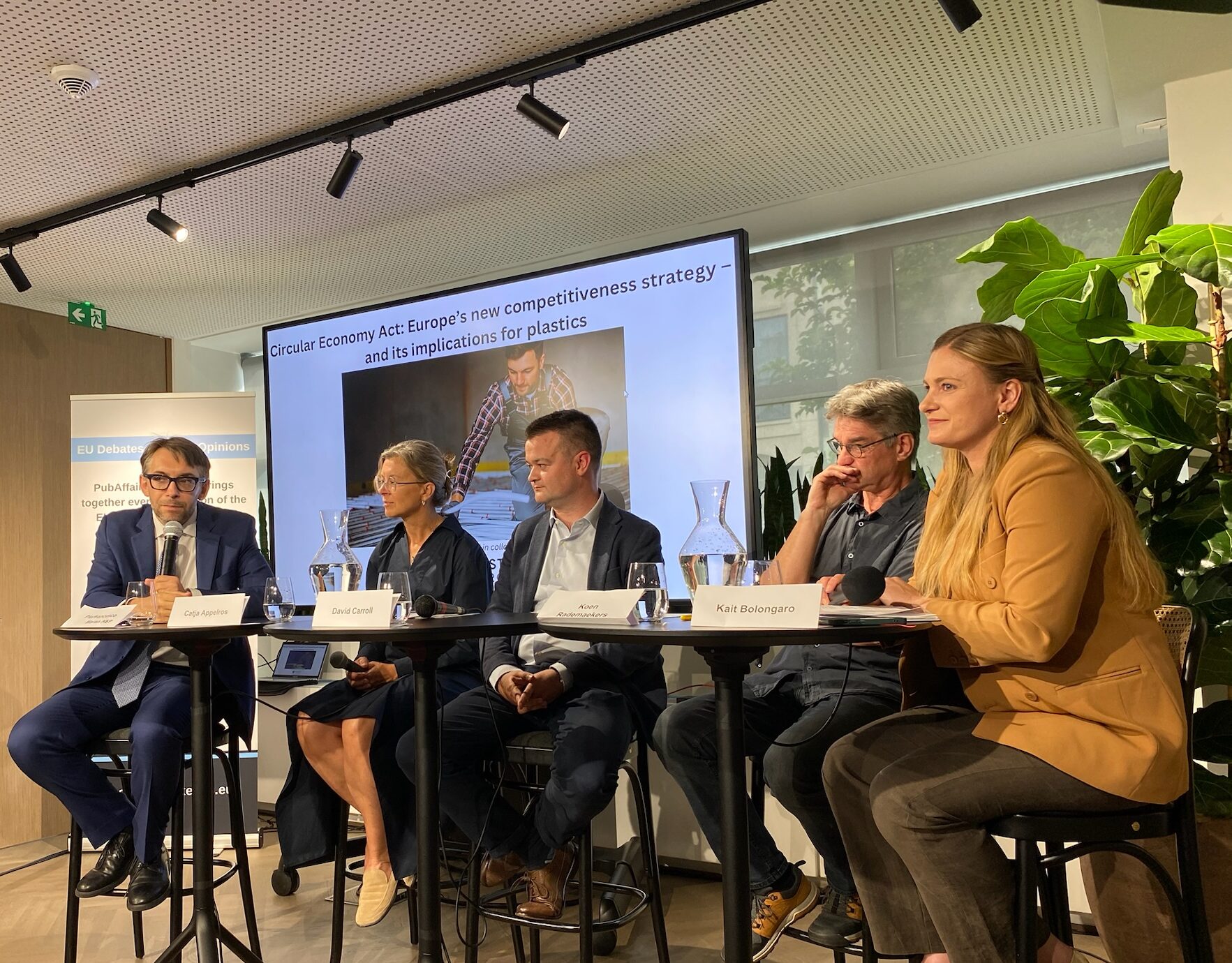

Kait Bolongaro opened the debate by welcoming the audience and inviting Virginia Janssens for some introductory remarks before introducing the panel.
Virginia Janssens welcomed the audience and panellists and introduced the discussion on the proposed legislative initiative named Circular Economy Act. She started her speech by noting that, while circularity has traditionally been viewed as an environmental issue, it has become increasingly central to debate on European competitiveness, resilience and strategic autonomy, making the forthcoming legislation a crucial policy initiative.
She then argued that the European plastics industry is at a critical juncture. Referring to her organisation’s latest report on the circular economy for plastics, she observed that, although circular plastics production continued to grow between 2022 and 2024, the pace of growth had slowed significantly, with a similar trend visible in demand from European converters for circular plastics. Against this backdrop, she welcomed the upcoming recycled content targets set under the Packaging and Packaging Waste Regulation (PPWR), describing them as an important driver for future market development.
Ms Janssens stressed that the slowdown in circularity is not only an environmental concern, but also a challenge for Europe’s industrial competitiveness. She pointed to high energy and carbon costs, feedstock disadvantages, global overcapacity, increasing imports and dumping cases as structural pressures affecting the sector, arguing that companies are being asked to invest in the circular transition whilst addressing significant short-term survival during a vital long-term transformation.
In this context, the speaker argued that the Circular Economy Act should support both industrial competitiveness and the transition to circularity through clear, targeted and actionable policy measures that would be able to scale circular economy models. She also called for legislation that is implementable, enforceable and harmonised across EU member states, whilst emphasising the importance of policy coherence with the EU’s broader industrial, energy, trade and climate agendas. Additionally, she underlined the need to harmonise to the largest extent possible the Single Market for circular products, secondary raw materials as well as circular services.
Virginia Janssens subsequently stressed that legislation alone will not be sufficient to address the competitiveness crisis and underlined the need for shared responsibility and collaboration across the entire value chain, involving industry, policymakers at European, national and local level, as well as citizens and consumers. Whilst acknowledging that the transition will require significant investment and entail short-term costs, she argued that decisive action, political commitment, effective communication and broad stakeholder cooperation are essential to secure Europe’s long-term prosperity and industrial resilience goals.
The speaker highlighted that the plastics industry extends far beyond single-use applications, playing a key role across critical sectors including healthcare, food systems, clean energy, mobility and construction. Stressing that plastics underpin several of Europe’s critical value chains, she argued that maintaining a competitive European plastics industry is essential for the EU’s industrial ecosystem as well as for economic security and strategic autonomy.
Against the backdrop of increasing pressure on the sector and the potential closure of industrial assets, she warned that the window of opportunity to secure the plastics industry’s transition is narrowing, and called for stronger coordination within the European institutions, closer cooperation between the co-legislators, and greater political ownership from member states to support Europe’s industrial base, including through more private and public financial tools, whilst acting beyond mere national interests.
In her conclusion, she emphasised that the current situation requires urgent and collective action rather than a “business as usual” approach. She encouraged an honest and fruitful debate among stakeholders with different perspectives with the aim of developing broader policy recommendations that can foster effective EU and national legislation on the circular economy.
Kait Bolongaro thanked Virginia Janssens and opened the panel discussion. She emphasised that the proposed Circular Economy Act should be viewed not only as an environmental initiative but also as a vital component of the EU’s broader competitiveness, industrial strategy, and economic security agenda. She noted that the proposal aims to establish a genuine European market for secondary raw materials while reducing the EU’s dependence on imported resources, raising critical questions about resource scarcity, industrial competitiveness, and the future of European manufacturing.
She then invited the panellists to examine these challenges from their respective perspectives, beginning with the economic rationale underpinning the Circular Economy Act. Addressing Koen Rademaekers, she asked what economic problem the Circular Economy Act is intended to resolve.
Koen Rademaekers argued that the Circular Economy Act should be understood not only as an environmental initiative but also as an economic and industrial policy instrument with significant implications for Europe’s employment, competitiveness and strategic autonomy. Drawing on his experience of working on circular economy initiatives in both Europe and Africa, he highlighted the global influence of EU legislation and identified the Ecodesign for Sustainable Products Regulation (ESPR) as a key legislative framework supporting the transition to a more circular economy. He also identified three principal objectives of the Circular Economy Act, namely strengthening the integration of the EU market for secondary raw materials; enhancing industrial competitiveness through increased use of recycled materials; and reducing the EU’s dependence on imported resources.
While welcoming these ambitions, he argued that greater cooperation among EU member states would be necessary to improve market integration, including through more consistent enforcement of product standards for imported goods. He also noted that meeting the EU’s recycled content targets would require a substantial increase in the use of secondary raw materials in the coming years.
In conclusion, Mr Rademaekers suggested that the scope of the Circular Economy Act could be broadened beyond its current focus on sectors such as electronics, critical raw materials, construction, packaging, textiles and chemicals, in order to promote circularity across a wider range of industries.
The moderator then turned the discussion to the role of plastics within the Circular Economy Act, questioning whether public and policy debates remain overly focused on single-use plastics. Referring to the sector’s broader contribution to European industry, she invited the panellists to consider the wider role of plastics in supporting the EU’s industrial strategy.
David Carroll replied by arguing that discussions on plastics should reflect the material’s essential role across a wide range of strategic sectors, including construction, automotive, electronics, infrastructure, medical devices and agriculture, rather than focusing predominantly on single-use applications. While acknowledging the circularity challenges associated with plastics, he stressed that these sectors also present significant opportunities to advance the circular economy.
He noted that a substantial proportion of plastic waste generated in the EU continues to be incinerated or sent to landfill despite more than a decade of circular economy policies, highlighting the need for more effective collection, sorting and recycling systems. In this connection, he argued that the Circular Economy Act should complement existing product design and recycled content requirements by ensuring that the necessary waste management infrastructure is in place, thereby enabling secondary raw materials to be recovered and reintroduced into the production cycle.
Turning to the role of the energy sector, the moderator invited reflections on its contribution to the circular economy debate. She asked Catja Appelros how the energy sector fits into this broader discussion.
Catja Appelros challenged the common perception that plastic waste is a desirable feedstock for energy recovery, arguing instead that plastics should be sorted and recycled as close to their source as possible. She emphasised the close relationship between the energy and the plastics sectors, noting that plastics production is highly energy-intensive and that increasing reuse and recycling would significantly reduce energy demand and dependence on fossil fuels. She added that the same principle applies to other energy-intensive materials, such as steel and aluminium.
The moderator invited the panellists to reflect on how the Circular Economy Act should balance its multiple objectives, asking which priority policymakers should focus on as the legislation is finalised. Addressing David Carroll, she asked what single change he would make to the legislation before its final adoption.
David Carroll argued that, while the Circular Economy Act represents a crucial step for the future of the plastics industry, it should not be regarded as a standalone solution. He stressed that restoring Europe’s leadership in circularity will be essential to strengthening the sector’s long-term competitiveness, describing it as fundamental to the industry’s future.
At the same time, he noted that fossil-based plastics will continue to play a significant role in critical applications during the transition. He therefore called for the legislation to be embedded within a broader industrial policy framework that balances circularity objectives with the sector’s economic and competitiveness challenges, whilst recognising the role of existing industrial assets in financing the transition.
The moderator then asked Koen Rademaekers whether the EU’s growing emphasis on strategic autonomy has changed the way policymakers approach circularity and trade, particularly in light of Europe’s dependence on imported resources.
Koen Rademaekers argued that the circular economy has become a crucial element of EU economic policy, but also stressed that the effectiveness of EU legislation depends not only on its design but also on its implementation and enforcement. While describing the European Green Deal as an important policy foundation, he suggested that insufficient attention has been paid to the capacity of member states to implement and enforce its measures, particularly in smaller countries with limited administrative resources.
Looking ahead, he welcomed a stronger emphasis on industrial policy under the current European Commission, arguing that greater strategic autonomy is essential to preserving Europe’s industrial base and reducing external dependencies. In this connection, he described the Circular Economy Act as a strategic instrument for strengthening the EU’s industrial resilience and competitiveness.
Seeking the energy sector’s perspective, the moderator asked what lessons could be drawn from recent regulatory and geopolitical developments and how the Circular Economy Act could support the sector’s transition.
Catja Appelros emphasised that electrification is one of the most cost-effective pathways to decarbonisation, particularly in the transport, heating and industrial sectors, and therefore plays a central role in reducing Europe’s dependence on fossil fuels. She also highlighted the importance of improving waste management, arguing that recyclable materials should be recovered as early as possible in the value chain, while non-recyclable waste should be used for energy recovery rather than being sent to landfill.
She expressed the hope that the Circular Economy Act, together with its related legislation, would strengthen recycling systems, reduce the amount of waste sent to landfill, and promote a more efficient use of resources, thereby contributing to both the EU’s climate objectives and Europe’s energy security.
The discussion then turned to the role of secondary raw materials in strengthening Europe’s strategic autonomy, with the moderator asking Koen Rademaekers whether they should be regarded as strategic assets.
Koen Rademaekers argued that this approach may be the only viable option for Europe, given the EU’s efforts to diversify its sources of critical raw materials and reduce its dependence on a limited number of suppliers. He stressed the importance of improving the collection, repair and recycling of products such as electronics and batteries in order to maximise the recovery of valuable materials. Referring to the steel sector as an example, he noted that the increasing use of recycled scrap demonstrates how circularity can enhance both resource efficiency and industrial competitiveness, when supported by appropriate recycling infrastructure and access to renewable electricity.
Building on this point, David Carroll emphasised the need for a value chain approach to the sectors that Europe seeks to protect. He argued that efforts to preserve strategic industries such as automotive, electronics and defence should be accompanied by measures to secure access to the materials required to manufacture these products within Europe, including plastics and recycled feedstocks. Responding to a further question on the “Made in Europe” agenda, he stressed that strengthening European manufacturing should go hand in hand with an open and balanced trade policy. While supporting greater domestic production and strategic resilience, he argued that maintaining exports remains essential to Europe’s industrial base and competitiveness and should continue to be reflected in EU policymaking.
The moderator then welcomed MEP Pierfrancesco Maran, inviting him to reflect on whether the EU’s growing focus on strategic autonomy is reshaping its approach to trade and circularity.
Pierfrancesco Maran MEP described the Circular Economy Act as the next step in the EU’s broader transition towards a circular economy, arguing that its success will depend not only on increasing recycling rates, but also on creating a strong market for secondary raw materials, including recycled plastics.
He highlighted the importance of stimulating demand for recycled plastics through sector-specific legislation, referring to the recently concluded End-of-Life Vehicles Regulation as an example of how recycled content targets can provide greater certainty for industry. He also stressed the importance of strengthening the “buy European” dimension of the EU’s industrial strategy, arguing that developing domestic markets for recycled materials would improve quality assurance and reinforce environmental standards, as these cannot be guaranteed when relying on imported secondary raw materials. He further noted that developing a domestic market for recycled materials could enhance the resilience of European industry in an increasingly fragmented global trading environment.
Adding on to the MEP’s remarks, Catja Appelros questioned whether the forthcoming legislative framework would go far enough to facilitate high-quality recycling in practice. She highlighted the importance of product design, asking whether the EU ecodesign requirements would sufficiently simplify material composition and improve product recyclability, rather than remaining largely theoretical.
On a similar note, David Carroll welcomed the inclusion of recycled content targets in the automotive sector, describing them as an important step towards creating stable demand for secondary raw materials. He argued that similar market-based measures should be extended to other applications for plastics, whilst also recognising the role of alternative sustainable carbon sources, such as bio-based plastics. He concluded that the Circular Economy Act should combine demand-side measures, industrial competitiveness, and investment incentives to create the conditions for an effective and economically viable circular plastics economy.
The moderator then turned to Pierfrancesco Maran MEP, asking whether the proposed Circular Economy Act, together with initiatives such as the Critical Raw Materials Act, the Carbon Border Adjustment Mechanism (CBAM), and other related legislation, provides a coherent policy framework.
Responding, Pierfrancesco Maran MEP argued that the EU’s circular economy framework is still evolving and should be viewed as part of a broader policy process rather than as a fully coherent or finalised framework. He observed that the European Green Deal, initially focused primarily on environmental objectives, has increasingly incorporated considerations relating to competitiveness, industrial policy, and economic resilience. He also highlighted that policymakers must keep in mind the need to pursue multiple objectives simultaneously.
The MEP continued by noting that changing geopolitical and economic circumstances, including the Covid crisis and Russia’s full-scale invasion of Ukraine, have reshaped EU priorities and opened debates that were previously considered political taboos, such as supporting European production through “buy European” approaches.
Referring to recent discussions on end-of-life vehicles and recycled plastics, he suggested that policy positions continue to evolve alongside the EU’s broader strategic objectives. In this connection, he described the Circular Economy Act as an important step in an ongoing policy process.
The moderator then broadened the discussion to the international dimension, asking how the EU’s partners perceive initiatives such as “buy European” and the growing emphasis on strengthening domestic production and sourcing.
Koen Rademaekers observed that several of Europe’s international partners, particularly in Africa, are also pursuing greater economic self-sufficiency by developing domestic value chains for strategic industries. Drawing on his recent experience in Zambia, he highlighted the efforts to establish local battery value chains based on the continent’s critical raw materials, arguing that these developments require the EU to rethink its approach to international partnerships. He also advocated for closer cooperation with African countries that supports local value creation and employment while delivering mutual economic benefits.
In conclusion, Mr Rademaekers stressed that achieving the objectives of the circular economy will require a level playing field for circular products. He also argued that market forces alone will not be sufficient to drive the transition and called for a combination of incentives, regulation and targeted policy measures to accelerate the uptake of circular business models and recycled materials.
The moderator then asked David Carroll how policymakers should interpret the simultaneous growth in ambitions for circular plastics and the decline in Europe’s fossil-based plastics production.
David Carroll argued that while fossil-based plastics production in Europe has declined, demand has remained broadly unchanged and has increasingly been met through imports. He cautioned that reducing domestic production without reducing overall consumption does little to advance the EU’s strategic or environmental objectives, particularly given the continued demand for plastics across a wide range of industrial applications.
While reaffirming the importance of accelerating the transition to circularity, David Carroll stressed that, in his opinion, progress remains too slow for circular production to replace conventional production at the required scale. He therefore argued that policy should focus not only on promoting circular plastics but also on ensuring that Europe’s industrial capacity remains competitive throughout the transition.
The moderator then asked what conditions are still needed to encourage investment in Europe and provide businesses with the certainty required to support the circular transition.
Catja Appelros replied by arguing that a simpler, more harmonised, and more predictable regulatory framework is essential to unlock investment. She suggested that the current policy focus on resilience and strategic autonomy provides an opportunity to accelerate the sustainability agenda, provided that environmental objectives are not weakened in the process. She also highlighted the need for stable market signals and a predictable regulatory framework to support electrification and called for continued investment in electricity grids, including distribution networks, flexibility and energy storage as part of the EU’s broader energy transition.
Turning to the legislative process, the moderator asked MEP Pierfrancesco Maran whether the ambition behind the Circular Economy Act had evolved as it became increasingly linked to competitiveness and industrial policy.
Pierfrancesco Maran MEP acknowledged the importance of simplifying EU legislation. However, he cautioned that lengthy legislative revisions could delay implementation. Referring to the recommendations of the Draghi Report, he argued that the policy debate has excessively focused on the question of regulatory simplification while paying insufficient attention to the scale of investment required to support Europe’s green and industrial transition.
In his view, Europe’s competitiveness challenge stems less from excessive regulation than from insufficient public and private investment, as well as the absence of a fully-fledged savings and investments union. He therefore called for stronger EU-level action, including increased investment and deeper economic integration, to strengthen the Union’s long-term competitiveness and support the objectives of the circular economy.
The moderator then asked each panellist how the success of the Circular Economy Act should ultimately be measured in terms of strengthening Europe’s competitiveness.
Koen Rademaekers argued that success will depend on effective implementation and enforcement across member states. While noting that recycling performance still varies significantly across the EU, he stressed the importance of improving waste management systems, strengthening the enforcement of existing legislation and developing more robust data collection to monitor progress and evaluate the Act’s impact.
David Carroll emphasised the need for a harmonised European framework combining clear objectives with the practical tools required to achieve them, including investment, enabling policies, and effective collection and sorting systems. He argued that success should be reflected in the growth of circular production within Europe rather than in increased reliance on imported recycled materials.
Catja Appelros highlighted reductions in fossil fuel imports, greater electrification and higher recycling rates across key material streams as important indicators of progress towards both competitiveness and sustainability objectives.
Pierfrancesco Maran MEP argued that the Circular Economy Act should strengthen the functioning of the Single Market while encouraging innovation across the EU. He suggested that successful implementation would require greater mutual recognition of new technologies and regulatory approvals between member states, enabling innovative circular solutions to be deployed more rapidly across the Union. He also stressed that the EU’s circular economy efforts should have an impact beyond its borders by promoting higher environmental standards internationally while safeguarding the competitiveness of European industry.
Looking ahead, the moderator asked Pierfrancesco Maran MEP to identify the next political decisions needed to advance Europe’s circular economy and industrial ambitions.
Pierfrancesco Maran MEP argued that negotiations on the EU’s next Multiannual Financial Framework (MFF) will be decisive in shaping the Union’s long-term priorities. He maintained that achieving Europe’s competitiveness and circular economy objectives will require a substantially larger EU budget capable of supporting future-oriented investment, rather than maintaining existing spending patterns.
The moderator then asked Catja Appelros about the greatest opportunity over the next five years.
Catja Appelros identified electrification as the key driver of Europe’s energy transition and industrial decarbonisation.
Turning to the investment climate, the moderator asked David Carroll what would determine whether companies continue to invest in Europe.
David Carroll emphasised the importance of a stable and predictable regulatory framework, arguing that policy certainty is essential for investment decisions. While supporting regulatory simplification where appropriate, he cautioned that reopening or delaying previously agreed legislation could weaken market demand and undermine the business case for investment in Europe’s circular economy transition.
Concluding the discussion, the moderator asked Koen Rademaekers to identify the greatest economic risk facing Europe.
Koen Rademaekers argued that Europe’s continued dependence on external partners remains a major vulnerability, while stressing that the EU must also improve the functioning of its internal market. He called for closer cooperation among member states, arguing that regulatory fragmentation and administrative complexity continue to create unnecessary barriers for businesses, particularly industrial companies operating across borders.
Reflecting on Europe’s past loss of industrial leadership in sectors such as photovoltaics, he stressed the importance of a coherent industrial policy to preserve and strengthen Europe’s manufacturing base. He concluded that deeper cooperation among member states, greater coordination at EU level, a stronger Single Market, and reduced administrative burdens will be essential to support industrial competitiveness and secure Europe’s long-term economic future.
The moderator then opened the Q&A session and invited questions from the audience. A participant asked how EU institutions could encourage greater political commitment from member states to strengthen harmonisation and improve the functioning of the Single Market for the circular economy.
In response, Pierfrancesco Maran MEP referred to the Draghi and Letta reports as important frameworks for deepening European integration and completing the Single Market. He argued that industry associations have an important role to play in supporting these objectives and stressed that differing national definitions and rules governing waste continue to undermine the development of a genuine European circular economy.
Pierfrancesco Maran MEP maintained that the success of the Circular Economy Act will depend on its ability to establish a true single market for waste and secondary raw materials, enabling the development of integrated European value chains. While expressing confidence that the European Commission is committed to this objective, he noted that the final outcome will depend on negotiations with the Council and the willingness of member states to support greater harmonisation.
Subsequently, the moderator opened the floor to questions from the audience.
A member of the audience highlighted the importance of regulatory certainty and industry alignment in unlocking private investment in the circular economy. Referring to the Packaging and Packaging Waste Regulation (PPWR), he argued that maintaining agreed timelines and policy ambition is essential to provide confidence for investors. He also called for a more unified position across the plastics value chain, asking David Carroll how the industry can demonstrate a consistent commitment to the transition and provide the certainty required to mobilise long-term private investment.
Responding to the question, David Carroll reaffirmed Plastics Europe’s support for key circular economy legislation, including the Packaging and Packaging Waste Regulation (PPWR) and the End-of-Life Vehicles (ELV) Regulation. While acknowledging that implementation challenges remain, he cautioned against reopening agreed legislation, arguing that doing so could weaken the ambition of existing measures and create uncertainty for industry and investors.
David Carroll also emphasised that regulatory certainty alone will not be sufficient to drive investment. He argued that companies also require viable market conditions, pointing to weak demand, high energy and carbon costs, and increasing competition from imported materials as key challenges affecting the sector. In his view, establishing a sustainable business case for circular plastics, alongside access to financing, will be essential to deliver the investments required for the transition.
Another member of the audience raised the issue of demand creation for secondary and bio-based raw materials. With reference to the indications that demand targets for recycled and bio-based content may be addressed through sector-specific legislation rather than the Circular Economy Act itself, she asked for reactions to this approach and which policy instruments would be most effective in creating a European market for circular materials.
David Carroll responded that there are multiple ways to stimulate demand, regardless of whether such measures are included in the Circular Economy Act. He stressed that predictable demand signals remain essential to encourage investment in recycled and bio-based plastics, noting that existing targets under sectoral legislation have yet to generate sufficient market demand. He suggested that further opportunities could arise through the Ecodesign for Sustainable Products Regulation (ESPR), as well as other sector-specific initiatives and industrial alliances, provided that they create stable and long-term market incentives.
Koen Rademaekers argued that legislation is indispensable for creating demand, as market forces alone tend to drive change too slowly. Citing the Ecodesign framework as an example, he highlighted its success in improving the energy performance of products through clear regulatory requirements developed in cooperation with industry. He also pointed to Green Public Procurement as an underused policy instrument, arguing that it currently has limited impact due to insufficient implementation and enforcement. He suggested that stronger application of these mechanisms could significantly stimulate demand for circular products and support the development of European markets for secondary raw materials.
A further audience member broadened the discussion by asking whether the Circular Economy Act should move beyond material recycling towards a more holistic circular carbon economy, including technologies such as chemical recycling and waste-to-chemicals pathways that recover carbon from plastic waste for the production of new materials.
Catja Appelros responded by acknowledging the potential of emerging technologies, including pyrolysis and carbon capture, utilisation and storage (CCUS), to recover carbon from waste streams and produce new materials. However, she noted that these solutions are not yet commercially viable at scale, limiting their current deployment. While expressing confidence that they could play a greater role in the future, she argued that stronger economic incentives and a higher value placed on recovered carbon will be needed to support their development and market uptake.
A different audience member asked Pierfrancesco Maran MEP how Europe can reduce its reliance on public funding while meeting its substantial investment needs for the green transition.
Pierfrancesco Maran MEP argued that completing the Capital Markets Union would be a key step towards unlocking additional private investment across the EU. He suggested that recent initiatives, including the digital euro, could contribute to this broader objective by supporting deeper financial integration.
Koen Rademaekers stressed that the availability of capital is not the main constraint. Rather, he stated, investors require attractive and predictable investment opportunities. He also argued that long-term regulatory certainty, stronger profitability and greater clarity about the future direction of policy are essential to making circular economy sectors more attractive to private investors. Given that investments in industrial infrastructure typically span several decades, he concluded that stable policy frameworks are indispensable for mobilising long-term capital.
An event attendee asked where the most significant data gaps lie in ensuring that the Circular Economy Act can be effectively implemented and enforced.
Koen Rademaekers highlighted the lack of comprehensive and harmonised circular economy data across the EU as a major challenge. Drawing on work carried out for the European Investment Bank to develop a circular economy database, he noted that significant gaps remain in data availability, particularly due to the limited provision of relevant information by member states.
He also argued that the absence of consistent data on material flows, waste, and other circular economy indicators makes it difficult to monitor progress, assess policy impacts and support effective enforcement. At last, he pointed out that defining and measuring circularity across different sectors remains a complex task, requiring further methodological development and greater cooperation at European level.
Another event attendee raised the question of financial incentives for the circular economy, referring to proposals such as differentiated “green VAT” rates and asking how the EU could create stronger economic incentives for circular business models in the current political and economic context.
Pierfrancesco Maran MEP acknowledged the potential of a “green VAT” but noted that changes to EU VAT rules require unanimous agreement among member states making such reforms politically difficult to achieve. While suggesting that alternative fiscal instruments could be explored, he cautioned that they would need to be carefully designed to avoid unintended consequences.
Koen Rademaekers observed that some member states are already examining alternative taxation mechanisms, including targeted taxes on specific products to encourage the use of circular materials over virgin resources. He argued that such approaches may prove more feasible than reforming the VAT system at EU level.
David Carroll stressed that, where environmental taxes or levies are introduced, the resulting revenues should be reinvested to support the circular transition. Referring to the EU’s plastics levy, he argued that greater earmarking of revenues for circular economy objectives would strengthen the effectiveness of such instruments. He also suggested that revenues from the EU Emissions Trading System (ETS) could play a greater role in financing the transition.
Concluding the round of replies, Koen Rademaekers highlighted the potential of Extended Producer Responsibility (EPR) schemes, noting that well-designed and transparent systems have proven effective in some sectors. He argued that identifying and replicating best practices will be important to ensure that financial instruments provide meaningful incentives for circularity rather than creating unnecessary administrative burdens.
In a final round of reflections, the moderator asked the panellists to identify the single policy measure that would make the greatest difference to Europe’s industrial competitiveness.
Pierfrancesco Maran MEP argued that the EU should place greater emphasis on investment rather than additional regulation, stressing that long-term competitiveness will depend on mobilising sufficient financial resources to support the transition.
David Carroll cautioned against viewing any single policy measure as a solution, advocating instead for a comprehensive industrial policy approach that addresses the multiple challenges facing European industry.
Koen Rademaekers similarly emphasised the importance of effective implementation and enforcement of existing legislation, calling for closer cooperation among member states and further simplification of the regulatory framework.
Catja Appelros highlighted the importance of a consistent carbon pricing framework across the EU.
Do you wish to know more about the issues discussed in this debate? Then check out the selected sources provided below!
The European Green Deal, European Commission
The Draghi report on EU competitiveness, European Commission
Much more than a market (Letta Report), Council of the EU
Circular Economy Act, European Parliament
Dramatic slowdown in Europe’s transition to a circular plastics system, Plastics Europe
Packaging and Packaging Waste Regulation (PPWR), European Commission
EU Emissions Trading System (ETS), European Commission
Carbon Border Adjustment Mechanism (CBAM), European Commission
Extended Producer Responsibility (EPR), OECD
Carbon capture, utilisation and storage (CCUS), European Commission
Ecodesign for Sustainable Products Regulation (ESPR), European Commission
End-of-Life Vehicles Regulation, European Commission
Ecodesign requirements for more sustainable products, Council of the EU
New rules for a more sustainable EU automotive sector, European Parliament
Savings and investments union, European Commission
The 2028-2034 EU budget for a stronger Europe, European Commission
Solar energy, European Commission
Green public procurement, European Commission
