
On the 14th of July 2026, PubAffairs Bruxelles organised an afternoon of discussion on the industrial, environmental, economic and supply chain challenges reflected in the automotive secto. This event was also a timely opportunity to discuss how the recently proposed Automotive Package could introduce greater flexibility whilst still allowing the EU to meet its competitiveness and climate objectives, with our distinguished speakers: Zala Černilec-Tomašič MEP (EPP/SI); Thomas Pellerin-Carlin MEP (S&D/FR); Christophe Grudler MEP (Renew Europe/FR); Isabel Scheckenbach, Head of Climate Programme, CEPS; Frank Niederländer, Vice President Government Affairs Europe, BMW.
The discussion was moderated by Lyubov Pronina, Long-time Brussels Journalist.
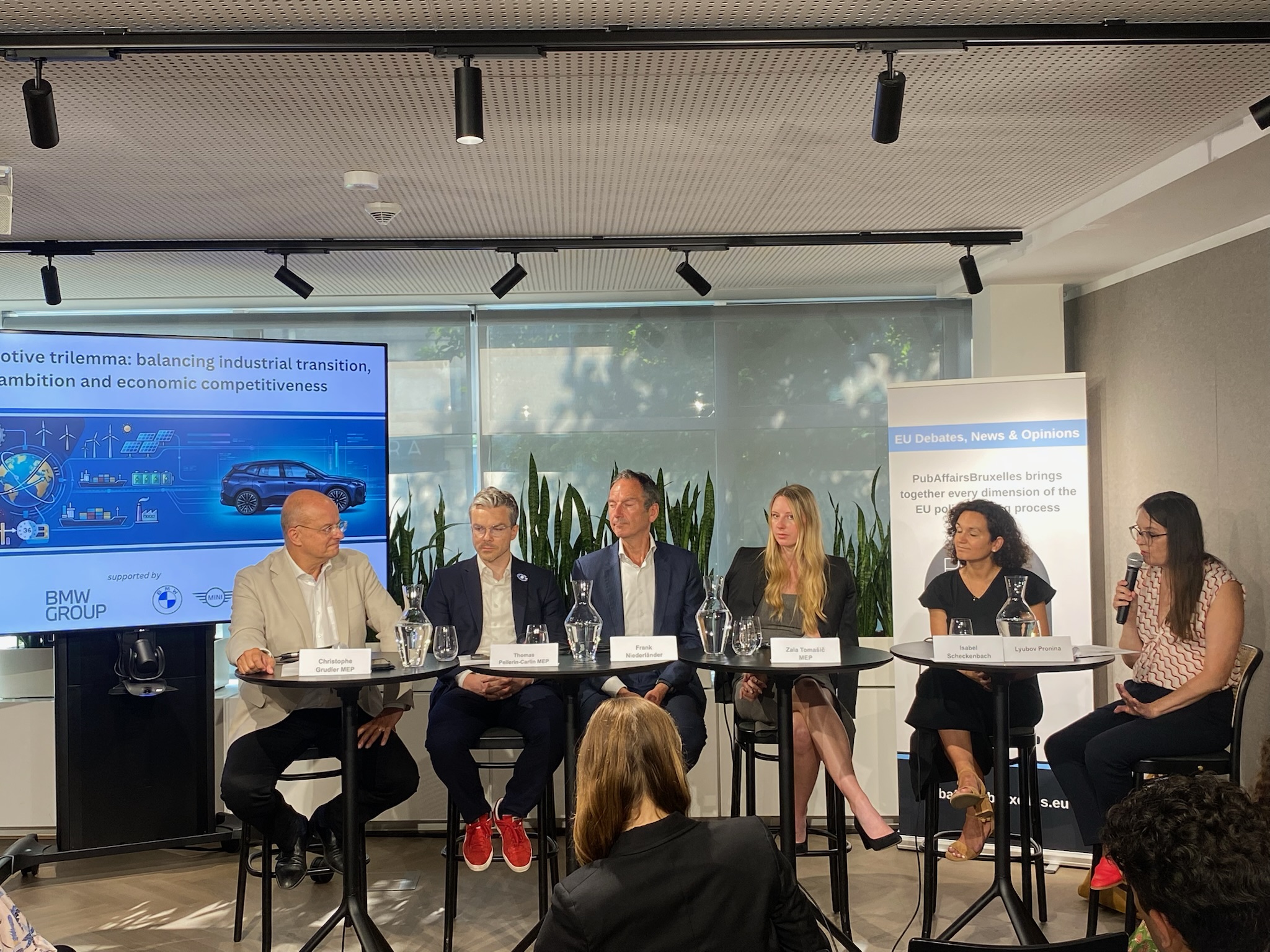

Lyubov Pronina opened the debate by welcoming participants and introducing the discussion on the EU’s industrial transition and the future of the European automotive sector. She underscored the sector’s strategic importance as a cornerstone of Europe’s industrial base, accounting for around 7% of EU GDP and supporting approximately 13 million jobs. Beyond vehicle manufacturing, she highlighted its wider ecosystem of suppliers, software developers, battery manufacturers, logistics operators and SMEs, emphasising its central role in driving innovation, competitiveness and economic transformation.
She also noted that the industry is undergoing a profound transition while facing mounting challenges, including job losses, plant closures, declining profit margins and heightened geopolitical uncertainty. At the same time, manufacturers are making significant investments in electrification and digitalisation amid intensifying global competition, particularly from China.
Placing these developments within the broader context of the EU’s climate objectives and the efforts to strengthen strategic autonomy and industrial resilience, the moderator referred to the European Automobile Manufacturers’ Association (ACEA), which has called for a regulatory framework that enables rather than constrains the sector’s transition and safeguards Europe’s industrial competitiveness. She then stressed that achieving the green transition will require a policy environment capable of supporting investment, innovation and industrial capacity.
Against this backdrop, the moderator framed the debate around the question of how Europe can preserve its global leadership in the automotive sector while advancing towards climate neutrality. She invited the panellists to consider how initiatives such as the Industrial Accelerator Act, the Automotive Package and the “Made in Europe” agenda could foster innovation and investment without undermining competitiveness, while ensuring that the transition remains both economically and socially sustainable.
She concluded by asking each speaker to identify the single most pressing challenge the sector will have to face over the next five years, namely regulation, energy prices, geopolitical tensions, access to critical raw materials or competition from China, before inviting Christophe Grudler MEP to respond first.
Christophe Grudler MEP responded that, in his view, the primary challenge facing the European automotive sector is competition from China. He argued that competition is unfair due to Chinese manufacturers, whose subsidy-based business model is weakening Europe’s automotive industry. He explained that this issue is also reflected in pricing, with Chinese cars entering the market with lower prices to outperform the competition and monopolise the industry. In this context, he added, initiatives such as the Automotive Package and the Industrial Accelerator Act are not intended to restrict competition, but rather to establish the conditions for fair competition. Further, he noted that, when these conditions are not respected, the EU must use the tools at its disposal to support its automotive industry.
MEP Grudler moved on to explain that the challenge for Europe is not the 2035 target itself, as the future of mobility will be electricity-driven, but rather the need to reduce dependence on others when it comes to energy importation. He stressed that accelerating electrification would be essential both to reduce dependencies and strengthen Europe’s automotive sector. The speaker also highlighted the importance of investing in research to ensure that Europe remains capable of maintaining its competitive position vis-à-vis the Chinese industry.
Finally, he emphasised the need for the EU to provide strong guidelines and a clear regulatory framework for the sector. This way, he argued, the EU could reassure investors and give them confidence in the future direction of the European automotive industry.
The moderator thanked Christophe Grudler MEP and invited Thomas Pellerin-Carlin MEP to share his views on the matter.
Thomas Pellerin-Carlin MEP agreed with Mr Grudler MEP’s observations on China being the number one challenge for the EU automotive sector. He elaborated on China’s success by clarifying it stems from strategic choices from which the EU should learn. More specifically, he noted that China has put forward a clear strategy, resisted pressure from vested interests and kept investing in cutting-edge technologies.
He also stressed that the country designated batteries as a strategic technology under Chinese law in 2003, with industry actors investing in battery research and development since then. By contrast, he pointed out that some European Original Equipment Manufacturers (OEMs) invested in software that was later found to be violating both EU and US laws.
Subsequently, Mr Pellerin-Carlin MEP went on to introduce the difference between lithium iron phosphate (LFP) and nickel manganese cobalt (NMC) batteries. He explained that the battery sector encompasses a great variety of technologies, among which LFP and NMC are the two leading battery technologies.
In this regard, he noted how Europe has heavily invested in NMC. Even though the LFP technology was originally Euro-Canadian developed in 2006, Europeans decided not to invest in it, because of its lower energy density and as it was perceived to be unsuitable for European car manufacturers’ needs. On the other hand, Chinese manufacturers embraced the LFP technology and consistently invested in it. Against this background, he emphasised that the dominant role that China is playing in the automotive sector largely depends on its early investment, research and development of LFP batteries. Mr Pellerin-Carlin MEP pointed out that European OEMs’ past decision of abandoning LFP and investing only in NMC batteries was a strategic mistake as both NMC and LFP technologies can be used in Europe, depending on the type of car being produced.
Concluding his remarks, he stressed the importance of avoiding hesitation in industrial policy decisions, namely avoiding frequent shifts in direction and maintaining consistency. He argued that the European automotive sector should learn from its mistakes and follow a path that has already been trotted, rather than resisting change. He then emphasised the need for constructive dialogue among stakeholders to ensure that Europe develops a fully-fledged value chain for electric vehicle (EV) production, from raw materials mining to end-of-life recycling.
The moderator then turned to Frank Niederländer and asked him to share his view on what was shared by the previous speakers.
Frank Niederländer opened his remarks by noting that the title of the event is emblematic, as it reflects a political debate in Europe that is finally approaching the automotive industry from all the relevant perspectives, namely sustainability, competitiveness and industrial transition. He observed that, during the previous legislative term, partly as a consequence of the so-called “Dieselgate” scandal, the discussion had focused primarily on environmental objectives, while the industrial transition dimension had received comparatively less attention.
Building on Mr Pellerin-Carlin MEP’s earlier remarks on China, Dr Niederländer highlighted the remarkable growth of the Chinese automotive industry over recent decades. He recalled that, twenty years ago, the sector was at a very different stage of development, with annual sales of around 800,000 vehicles, whereas today China has become one of the world’s largest automotive markets, with approximately 20 million new energy vehicles (NEVs) sold each year, making up more than 50% of total domestic new car sales.
He subsequently argued that this transformation should serve as a source of inspiration for Europe, demonstrating that substantial industrial growth is achievable. Against a broader geopolitical landscape, he noted that major economies – including China, India, countries across Latin America and the United States – are all pursuing strategies aimed at strengthening their domestic industrial base. In this regard, he stressed that competitiveness must become an integral component of the European Union’s industrial strategy.
Dr Niederländer then elaborated on the concept of competitiveness and how it should be assessed. In his view, competitiveness can ultimately be measured by the ability of companies to gain market share, as this constitutes the most meaningful indicator of whether an industrial actor is succeeding in the global marketplace.
Returning to the discussion on China, he reiterated the country’s rapid expansion and emergence as a major competitive force. He explained that the Covid pandemic had, on the one hand, made it more difficult to monitor ongoing industrial developments and, on the other, provided Chinese companies with an opportunity to accelerate the development of a broad range of innovative technologies. According to the speaker, this created a competitive disadvantage for Europe, as businesses depend on visibility into market developments and competitors’ strategies to adapt and innovate effectively. At the same time, he suggested that competing successfully in the Chinese market could act as a powerful driver of innovation and technological advancement within Europe itself.
Echoing previous interventions, Dr Niederländer also emphasised the importance of China’s long-term strategic planning. He observed that the country’s five-year plans are continuously reviewed and refined, enabling policymakers to reassess priorities and monitor implementation. He further noted that several of the strategic value chains Europe is currently seeking to develop have been at the core of the Chinese industrial policy for many years. As a result, he argued, the European Union is now attempting to make up for what could be described as a “lost decade” in terms of industrial innovation.
He went on to explain that China’s stronger economic growth has enabled it to finance this industrial transformation through sustained investment across multiple sectors. In this regard, he argued that Europe often associates China’s industrial development primarily with electric vehicles, whereas the country has in fact strengthened its capabilities across the wider technological ecosystem, including power generation, electricity grids and battery technologies. He added that Chinese industry is simultaneously investing in a range of propulsion technologies, from internal combustion engines to battery-electric vehicles and hydrogen-based solutions.
In his concluding remarks, Dr Niederländer reiterated the importance of developing a deeper understanding of China’s industrial development model while reinforcing Europe’s own industrial base and long-term competitiveness. He argued that relying solely on the protection afforded by the European market would only provide temporary relief and would ultimately prove insufficient to sustain competitiveness over the longer term.
Finally, he reflected on China’s willingness to tolerate intense competition among domestic companies, acknowledging that not all firms had survived and that market consolidation had ultimately resulted in a limited number of leading original equipment manufacturers (OEMs). Accordingly, he questioned how a comparable approach would be perceived and accepted within the European context.
Lyubov Pronina thanked Dr Niederländer for his contribution to the discussion. Building on his previous remarks, she emphasised the importance of Europe remaining competitive in the Chinese market and learning from China’s experience in order to strengthen the European Union’s industrial base and position itself as a more competitive global actor. She then invited Zala Černilec-Tomašič MEP to share her perspective on the issue.
Responding to the moderator’s opening question, Zala Černilec-Tomašič MEP argued that, while China undoubtedly represents a major challenge for Europe’s automotive industry, the situation is more nuanced than it is often portrayed. She stressed that any comparison between China and Europe must take into account the very different conditions under which their respective automotive industries have developed.
She also noted that China has subsidised its automotive sector for decades, investing heavily in original equipment manufacturers (OEMs) as well as in the creation of new domestic brands. At the same time, she highlighted that Chinese manufacturers have operated under a less restrictive regulatory framework, without being subject to measures comparable to the European Union Emissions Trading System (EU ETS). She further pointed to China’s access to comparatively inexpensive electricity, raw materials and critical resources, contrasting this with the European context, where higher environmental standards, higher labour costs and differing taxation regimes across member states all have a significant impact on the competitiveness of the automotive sector.
MEP Černilec-Tomašič further observed that, while Beijing had been providing financial support to its automotive industry, the European Union had introduced regulatory measures and penalties affecting its own manufacturers. Against this background, she argued that it would be overly simplistic to regard China alone as the principal challenge facing the European automotive industry. Instead, she called for a broader assessment that also considers structural issues such as energy prices, regulatory requirements and the overall business environment.
Looking ahead, MEP Černilec-Tomašič argued that the discussion should focus less on the factors that led to the current situation and more on shaping the future of the European Union. In her view, one of Europe’s most pressing challenges is the growing disconnect between legislation and industrial reality, a gap that policymakers should seek to address. Echoing previous speakers, she acknowledged that China has overtaken Europe in several technological and industrial fields, while still expressing confidence in the long-term prospects of the European automotive industry.
In this regard, she identified Europe’s long-standing automotive heritage as one of its enduring competitive strengths. She argued that, irrespective of the ongoing debate on regulation and emissions, French, German and Italian vehicles continue to enjoy a strong international reputation and remain widely regarded as symbols of quality and prestige. While recognising the rapid progress made by Chinese manufacturers, MEP Černilec-Tomašič maintained that European automotive brands continue to benefit from a well-established reputation for excellence.
Turning to the European regulatory framework, she argued that legislation should be better aligned with the realities faced by the industry. While acknowledging that battery electric vehicles will play an important role in the future of mobility, she insisted that the future is not necessarily exclusively electric but will undoubtedly need to be carbon-neutral.
In her concluding remarks, MEP Černilec-Tomašič invited members of the audience to indicate whether they owned a battery electric vehicle, a hybrid vehicle, a petrol or diesel internal combustion engine (ICE) vehicle, or no car at all. Referring to the relatively high number of participants who indicated that they did not own a vehicle, she observed that public transport often receives insufficient attention in broader discussions on mobility policy. She concluded by expressing her support for the further development of high-speed rail connections across Europe.
The moderator then invited Dr Isabel Scheckenbach to take the floor.
Isabel Scheckenbach opened her intervention by stating that she wished to introduce a different perspective to the discussion, focusing on climate and finance. She argued that, in the short term, the European automotive industry faces significant resilience challenges. In her view, automotive companies are not yet sufficiently incorporating climate-related risks into their business decisions. She mentioned heatwaves, which can disrupt production processes, reduce output and ultimately affect sales volumes.
She also referred to the growing risks associated with water scarcity in certain regions, which could directly impact manufacturing activities. Furthermore, she warned that Europe’s limited access to natural resources is likely to become an even greater challenge in the future. She argued that these risks are too often underestimated and stressed the importance of giving them greater consideration in EU decision-making.
Echoing the moderator’s earlier remarks, Dr Scheckenbach highlighted the complexity of automotive supply chains and pointed to China’s ability to develop a comprehensive industrial strategy. She explained that China’s approach extends beyond supporting vehicle manufacturers and encompasses the entire automotive ecosystem, including battery technologies. In particular, she noted that China has invested strategically in securing access to critical raw materials, including lithium and other minerals essential for the energy transition.
By contrast, she observed that the European automotive industry remains heavily dependent on external suppliers for many of these materials. In this regard, she referred to recent disruptions affecting the Strait of Hormuz as an illustration of the vulnerabilities associated with such dependencies. In conclusion, she argued that Europe should strengthen the resilience of its supply chains by increasing the localisation of production and bringing a larger share of the automotive value chain back to Europe.
The moderator then turned to Christophe Grudler MEP, in his capacity as co-rapporteur for the Industrial Accelerator Act, and invited him to explain how he would make the case for this legislative initiative.
Christophe Grudler MEP replied that the Industrial Accelerator Act is intended to strengthen investment across Europe’s strategic decarbonisation lead markets, including steel, aluminium, cement and the automotive sector, as well as key technologies such as renewable energy and nuclear energy, building on the framework established by the Net-Zero Industry Act.
He argued that achieving this objective first requires sending investors a clear and credible signal regarding the long-term direction of the European industrial policy, thereby providing regulatory certainty over a period of at least fifteen years. He further maintained that the European Union already has a range of instruments capable of supporting the development of these lead markets. In this context, he underlined the importance of reinforcing the principle of “European preference” in public procurement, alongside measures such as targeted purchasing incentives and corporate fleet policies.
MEP Grudler stressed that discussions surrounding the Industrial Accelerator Act should not be confined to the provisions directly affecting the automotive sector. Rather, attention should also be given to the broader set of policy instruments available to strengthen Europe’s industrial base. He further argued that, if the European Union is to attract greater investment, the legislative framework must remain firmly focused on Europe.
While acknowledging that this could be challenging for the automotive sector, given its longstanding reliance on globally integrated supply chains and imported components, he maintained that extending the scope beyond Europe could encourage investors, particularly from China and the Republic of Korea, to prioritise investments in third countries rather than within the European Union. He therefore reiterated the importance of ensuring that the legislative framework remains focused on strengthening Europe’s industrial capacity and attracting investment within the Union.
The moderator then turned to Thomas Pellerin-Carlin MEP and, building on his previous remarks on battery manufacturing, asked whether the Industrial Accelerator Act does enough to support the development of battery production within the European Union.
Thomas Pellerin-Carlin MEP began his intervention by inviting the audience to consider the issue from the perspective of an investor. He argued that the principal rationale for investing in battery manufacturing in Europe is to serve the European market itself, rather than to export batteries to China, which would not represent a viable strategic business case. Instead, he suggested that the European market, together with selected third-country markets seeking to reduce their dependence on China, particularly in South America and Africa, should constitute the primary commercial focus.
He went on to stress that battery manufacturing is fundamentally a scale-driven industry, where competitiveness depends largely on achieving high production volumes. In this context, he referred to the Energy Technology Perspectives report published by the International Energy Agency (IEA), which analyses the major clean technology sectors, including batteries, and examines the factors underlying the cost differential between products manufactured in Europe and those produced in China.
Drawing on the report’s findings, MEP Pellerin-Carlin argued that the outlook for Europe’s battery industry is encouraging, noting that approximately 70% of the current cost gap can be attributed to two factors directly related to economies of scale. The first is manufacturing efficiency. He explained that Europe could already narrow the cost differential significantly by adopting state-of-the-art production processes. He added that China has made greater progress in industrial automation because it invested earlier and at a larger scale, and argued that Europe must now accelerate its own industrial development to close this gap.
Referring to a concept developed by the French think tank Institut Montaigne, he suggested that Europe should replicate the strategy pursued by China since the 1980s by making access to the European market conditional upon the establishment of robust local value chains.
MEP Pellerin-Carlin then turned to the second factor identified in the International Energy Agency (IEA) report, namely the cost of battery components. He explained that the cathode and the anode constitute the two critical elements in battery production. While acknowledging that Europe still needs to strengthen its capabilities in anode production, he argued that the situation regarding cathode manufacturing is more favourable. In this regard, he highlighted the existence of projects already underway in Europe, including a joint venture involving one of the sector’s leading companies to manufacture cathode materials through a 51/49% partnership in Northern Europe.
He further argued that Europe’s battery industry is steadily catching up. Referring to IEA data, he stated that existing facilities in Europe already provide the capacity to produce approximately 1,070 gigawatt-hours (GWh) of batteries annually. In addition, he noted that a further 6,010 GWh of production capacity is in the pipeline through projects that are either under construction or have already reached a final investment decision (FID).
Against this backdrop, MEP Pellerin-Carlin argued that, by 2030, Europe could have sufficient battery manufacturing capacity to support the production of between seven and nine million electric vehicles annually, exceeding projected demand within the European Union. For this reason, he warned that any weakening of the existing regulatory framework would risk undermining ongoing industrial investments. He further argued that claims suggesting that the future of the automotive sector is not electric ultimately weaken investor confidence and jeopardise existing investment commitments.
MEP Pellerin-Carlin also argued that policymakers should follow a principle comparable to that applied in medicine: “first, do no harm”. He reiterated the importance of avoiding contradictory policy signals that could erode investor confidence. He also cautioned against repeating what he described as the policy reversals witnessed in the United States, which, in his view, contributed to significant asset devaluations affecting both American and European automotive manufacturers.
He concluded by arguing that, in his view, weakening the EU’s CO₂ standards would risk undermining the entire automotive value chain. In this connection, he expressed concern that political efforts to dilute what he described as one of the European Union’s strongest regulatory instruments, namely its long-term regulatory framework, could ultimately weaken its effectiveness in supporting industrial investment.
The moderator thanked Thomas Pellerin-Carlin MEP for his contribution and invited Zala Černilec-Tomašič MEP to share her views on the issues at stake raised by the French MEP.
Zala Černilec-Tomašič MEP began by expressing her agreement with MEP Pellerin-Carlin on the importance of developing battery production capacity within Europe. However, she argued that discussions on battery manufacturing often overlook a structural challenge, namely Europe’s limited access to the critical raw materials required for battery production. In this regard, she referred to the debate surrounding proposed lithium mining projects in Serbia, noting that these had generated significant public opposition due to concerns about their environmental impact.
She further observed that, even where Europe possesses relevant raw material resources, a substantial share of their processing and refining currently takes place in China. Against this backdrop, she reiterated the importance of reducing Europe’s dependence on fossil fuels, which she described as a strategic vulnerability. At the same time, she cautioned that an exclusive focus on battery electric vehicles could result in replacing one form of external dependency with another.
Turning to the debate surrounding the CO₂ emission standards for passenger cars and light commercial vehicles, whose legislative file is notably led by Massimiliano Salini MEP, Ms Černilec-Tomašič MEP argued that discussions are often characterised by misunderstandings regarding their underlying objectives. She clarified that the intention is not to prohibit the production or sale of battery electric vehicles. In her view, manufacturers would remain free to develop and market such vehicles, consumers would continue to be able to purchase them, and member states would retain the possibility of supporting their uptake through national incentive schemes. Rather, she argued that the objective is to preserve technological neutrality and consumer choice by ensuring that alternative vehicle technologies remain available alongside battery electric vehicles.
In her view, if an original equipment manufacturer (OEM) determines that battery electric vehicles represent the most appropriate commercial strategy, it should remain free to pursue that approach without interference from those advocating alternative propulsion technologies, such as internal combustion engine (ICE) vehicles or plug-in hybrid models. She also argued that policymakers should refrain from prescribing technological choices to industry and should instead establish a regulatory framework that enables manufacturers to determine the most appropriate technological pathway.
Thomas Pellerin-Carlin MEP directly responded to MEP Černilec-Tomašič’s remarks on critical raw materials and the legislative report led by MEP Salini. He began by asking members of the audience to raise their hands if they had ever visited a lithium extraction site. Observing that only one participant, apart from himself, had done so, he noted that such a site can be visited not far from Strasbourg.
He explained that this facility alone has the potential to extract sufficient lithium to manufacture close to one million battery electric vehicles (BEVs). He also referred to other extraction projects in southern France, Finland and Germany, before highlighting that Australia is currently the world’s largest producer of lithium, followed by Chile.
Against this backdrop, MEP Pellerin-Carlin argued that Europe is not necessarily constrained by the availability of lithium resources, as the raw material can also be imported from countries such as Australia and refined domestically. While agreeing with MEP Černilec-Tomašič that China’s dominant position in the battery sector is closely linked to its strength in refining, he maintained that refining capacity is primarily the result of long-term industrial policy choices rather than geological circumstances.
Turning to the report on CO₂ emission standards led by MEP Salini, MEP Pellerin-Carlin reiterated that European consumers would remain free to purchase electric vehicles. However, he argued that the central issue is regulatory predictability. In his view, the existing legislative framework provides investors with a high degree of certainty by establishing that, by 2035, all newly registered cars placed on the European market should be zero-emission vehicles.
He went on to argue that the European Commission’s proposal would reduce the expected share of battery electric vehicles from 100% to approximately 85%, while the approach advocated in the Salini report would deliver no certainty whatsoever. He concluded by arguing that any departure from a clear and predictable regulatory framework for such a strategic industrial sector would be unlikely to secure broad support within the European Parliament.
Christophe Grudler MEP intervened to clarify that Europe is not currently experiencing a shortage of critical raw materials. However, he cautioned that such a situation could arise should China decide to restrict exports. He noted that this was one of the reasons for which the European Parliament is currently working on the establishment of a Critical Raw Materials Centre, which is intended to create strategic reserves of essential materials and strengthen the security of supply for European battery production.
Responding to MEP Černilec-Tomašič’s earlier remarks, MEP Grudler stressed that the debate should not focus exclusively on mining, which he described as a longer-term solution, but should also encompass refining and recycling. He underlined the strategic importance of developing a competitive battery recycling industry in Europe, arguing that this represents a growing market that the European Union should actively support.
Lyubov Pronina invited Frank Niederländer to provide the industry’s perspective on MEP Černilec-Tomašič’s observations regarding consumer choice and manufacturers’ freedom to determine which vehicle technologies to produce and market. She also asked whether there was one particular change or policy measure that the speaker would like to see reflected the most in the Automotive Package.
Beginning his response from the latter question, Frank Niederländer observed that the answer largely depends on the specific legislative proposal under consideration. With regard to the Industrial Accelerator Act, he argued that the proposed timeline for battery-related provisions is the most critical issue.
He then broadened the discussion by reflecting on the earlier exchange between the panellists. In his view, the initial phase of the debate benefited from presenting the transition as a choice between electric and combustion technologies, as this helped generate political momentum. However, he questioned whether such a binary approach remains appropriate for managing the transition in practice.
Referring to BMW’s strategy, he explained that the company had deliberately adopted a technology-neutral approach by investing in five different propulsion technologies, including two types of internal combustion engines, battery electric vehicles, plug-in hybrid vehicles and, more recently, hydrogen-powered vehicles. While acknowledging that this strategy entails additional costs, he argued that it has enabled BMW to manage market uncertainty more effectively while adapting to changing consumer demand. According to the speaker, this approach has also contributed to increasing the company’s share of the battery electric vehicle market to approximately 25%.
Dr Niederländer argued that competitors relying on a single technological pathway had adopted a riskier business strategy. Responding to MEP Pellerin-Carlin’s remarks on regulatory predictability, he stated that he holds a fundamentally different view of the concept. While acknowledging that policymakers can create investment certainty by promoting a particular technology, he argued that market size ultimately remains the decisive factor for industrial competitiveness.
He also explained that, should the European automotive market decline from its current level of around 14 million vehicles annually, or from previous levels of 15 to 16 million, to approximately 9 million vehicles, Europe’s industrial scale would become significantly smaller than markets such as China, with around 20 million vehicles, or the United States, with around 16 to 17 million. In this context, he cautioned that pursuing the transition through a single technology without sufficient regard to market developments risks weakening both industrial production and Europe’s broader economic strength.
Echoing MEP Grudler’s earlier remarks, Dr Niederländer also addressed China’s industrial strategy. He argued that dominant industrial players seek to strengthen their economic position by maximising returns on investment, expanding domestic markets and progressively displacing competitors.
He also warned that Europe could eventually face a situation comparable to that experienced in the solar photovoltaic industry, where China established a dominant global position. For this reason, he stressed the importance of maintaining technological flexibility and avoiding what he described as overly dogmatic debates. Instead, he argued that policymakers and industry should focus on identifying practical policy instruments capable of strengthening Europe’s industrial competitiveness.
Returning to the moderator’s question, Dr Niederländer identified the implementation timeline contained in the forthcoming battery legislation as one of the most problematic aspects from an industry perspective. In particular, he argued that the requirement to comply within six months of the legislation’s entry into force is unrealistic. He added that several stakeholders, including some who had initially supported the proposed timetable, now recognise that it is no longer achievable under current circumstances.
Turning to the development of a European battery industry, Dr Niederländer sought to clarify a point raised earlier in the discussion. In his view, the difficulties encountered by several European battery projects were not caused by insufficient market demand or a lack of customer interest. Rather, he explained that BMW had carefully assessed a number of these projects but ultimately decided not to participate because the underlying technologies did not, at that stage, meet the company’s requirements in terms of industrial scale and product quality.
He nevertheless stressed that Europe is currently developing several major battery projects and that the sector continues to gain momentum. In his view, the market opportunity clearly exists, making cooperation across the industrial value chain essential. He argued that establishing a competitive European battery ecosystem requires the gradual development of the entire value chain, a process that inevitably takes time.
Referring to the earlier point raised on lithium iron phosphate (LFP) batteries, he suggested that Europe should focus on next-generation battery technologies rather than attempting to replicate mature technologies already produced elsewhere at scale. He added that prismatic battery technologies could represent a significant opportunity for Europe to establish a competitive position, particularly in smaller vehicle segments.
Concluding his reply, Dr Niederländer reiterated that Europe’s long-term success will depend on combining advanced technologies, industrial expertise, a highly skilled workforce and strong intellectual property capabilities. Bringing these elements together, he argued, requires a sustained long-term effort and cannot realistically be achieved within a matter of months.
Directly following up on his remarks, the moderator asked Frank Niederländer what actions legislators could take to better support both BMW and the European automotive industry more broadly.
Frank Niederländer explained that the industry’s approach is based on the principle of what was originally described as “technology neutrality”, although he acknowledged that the term has become increasingly contested in recent years. Substantially, he argued, the framework should rest on a limited number of clear criteria.
The first relates to vehicle assembly, which he described as an important consideration, with particular attention to the treatment of vehicles manufactured in the United Kingdom. The second concerns local content requirements for conventional automotive components, which, in his view, represent a fair mechanism for strengthening and safeguarding European suppliers. The third relates to batteries, which he characterised as a strategic component of the automotive value chain, stressing in particular the importance of establishing realistic implementation timelines for the relevant legislative requirements.
Dr Niederländer also highlighted a fourth element, namely the need to assess the overall value creation generated by a company rather than focusing exclusively on individual products. In this regard, he argued that a distinction should be drawn between companies whose headquarters, the vast majority of their workforce and their wider economic footprint are located in Europe, and companies from outside Europe that maintain only a limited manufacturing presence within the European Union. According to the speaker, the overall value generated within Europe should constitute a key criterion in assessing the contribution of automotive manufacturers to the European economy.
He further explained that, from a production perspective, all vehicles manufactured in Europe should contribute to European value creation, irrespective of whether they are ultimately sold within the European Union or exported to third-country markets. In his view, the ability to export vehicles successfully also demonstrates the global competitiveness of the European automotive industry.
Turning to CO₂-related legislation, Dr Niederländer underlined the importance of maintaining regulatory flexibility. He observed that, while the role of low-carbon fuels is particularly relevant for larger vehicles, a differentiated approach for smaller vehicle segments could be appropriate. In this context, he expressed support for stronger incentives, including enhanced super-credit mechanisms, for smaller vehicles.
At the same time, he raised concerns regarding the existing exemption framework, arguing that current rules could allow a vehicle to qualify as European despite relying extensively on non-European components, provided that it incorporates a battery manufactured in Europe.
In conclusion, Dr Niederländer questioned whether the current legislative framework fully reflects the European Union’s stated ambition to strengthen its industrial competitiveness and maximise value creation within Europe.
The moderator then invited Isabel Scheckenbach to take the floor and give a final overview of the issue at stake in the debate.
Responding to the debate on technology neutrality, Isabel Scheckenbach noted that available research indicates that battery electric vehicles (BEVs) outperform internal combustion engine (ICE) vehicles from a lifecycle emissions perspective after approximately two years of operation. She argued that this evidence should remain a central consideration in discussions on the future of European mobility policy.
Building on the earlier discussion on industrial competitiveness, Dr Scheckenbach also highlighted the comparatively slow pace of vehicle development within the European automotive sector. She then observed that Chinese manufacturers are typically able to develop and launch new vehicle models within 12 to 18 months, enabling them to test new technologies rapidly and incorporate customer feedback into subsequent product development.
By contrast, she noted that vehicle development cycles in the German automotive industry are estimated to last between five and six years. She concluded by arguing that European manufacturers should accelerate both innovation and product development in order to remain internationally competitive.
The moderator then turned to Zala Černilec-Tomašič MEP and invited her to share her final statements.
Zala Černilec-Tomašič MEP stressed that the overarching objective of European mobility policy should be environmental protection. She argued that policymakers should assess the full lifecycle of vehicles rather than focusing exclusively on tailpipe emissions. Referring to Thomas Pellerin-Carlin MEP’s earlier remarks, she acknowledged that France benefits from a relatively low-carbon electricity mix owing to its extensive use of nuclear power.
However, she also observed that significant differences remain across the European Union, with a substantial share of electricity generation in many Member States still relying on non-renewable energy sources. In this context, she emphasised the importance of considering the broader energy ecosystem, including electricity generation, grid capacity and the carbon intensity of electricity production, when assessing the sustainability of different vehicle technologies.
MEP Černilec-Tomašič further argued that all stages of a vehicle’s lifecycle, including manufacturing, operation and end-of-life treatment, should be taken into account in policy assessments. While acknowledging ongoing progress in battery recycling technologies within the European Union, she maintained that comprehensive lifecycle analyses should remain a key element of the policymaking process. Referring to BMW as an illustrative example, she also observed that modern internal combustion engine vehicles have become significantly more efficient and less polluting than previous generations.
Turning to the broader debate on battery electric vehicles, MEP Černilec-Tomašič acknowledged the continued growth of the electric vehicle market within the European Union. At the same time, she noted that hybrid and petrol-powered vehicles continue to account for a substantial share of overall vehicle sales. In her view, this underlines the importance of maintaining a technology-neutral regulatory framework.
Subsequently, she reiterated her view that policymakers should avoid prescribing specific technological pathways, arguing instead that innovation and market competition are better placed to determine which technologies ultimately prevail, without requiring regulatory prohibitions.
She went on to emphasise the importance of creating the enabling conditions necessary to support the uptake of cleaner vehicle technologies. In particular, she identified the insufficient availability of electric vehicle charging infrastructure across several member states as a significant obstacle to consumer adoption. Addressing these shortcomings, she argued, would encourage more consumers to purchase electric vehicles. She also highlighted the importance of affordable electricity prices, referring to her own experience of charging a plug-in hybrid vehicle in Italy, where she found that the cost of charging the battery exceeded the cost of refuelling with petrol.
In her concluding remarks, MEP Černilec-Tomašič highlighted the potential contribution of plug-in hybrid vehicles to the transition towards cleaner mobility. While acknowledging concerns regarding their real-world performance and patterns of use, she argued that policy efforts should focus on improving the deployment and use of the technology rather than limiting its development. In her view, manufacturers should be given the opportunity to continue investing in and demonstrating the potential of these technologies.
The Q&A session covered the following topics: the production costs and CO₂ targets; the impact of high energy prices; the relationship between competitiveness and regulatory mandates in the automotive sector; the affordability of electric vehicles for consumers; the potential contribution of vehicle conversion technologies; the EU’s decarbonisation of the automotive industry; stability and predictability needed by the industry; clean transition; the impact of the green transition on employment; high energy prices; EU’s dependence on fossil fuels; the need for greater European coordination and a faster decision-making process; the simplification of the Automotive Omnibus package; the future of small electric cars; the creation of a new category of cars; the future of EU mobility; consumer choice; the achievement of climate objectives.
Do you wish to know more about the issues discussed in this debate? Then check out the selected sources provided below!
Automotive Package, European Commission
Industrial Accelerator Act, European Commission
Net-Zero Industry Act, European Commission
Made in Europe, Speech, European Central Bank (ECB)
Critical Raw Materials Centre, European Parliament
Energy Technology Perspectives 2026, International Energy Agency (IEA)
The European Green Deal, European Commission
Europe-China: A new joint venture strategy for cleantech, Institut Montaigne
The Draghi report on EU competitiveness, European Commission
Much more than a market (Letta Report), Council of the EU
New energy vehicles (NEV) – an overview, Science Direct
What to know about LFP batteries, Midtronics
