
EU-US trade relations: Council moves forward in implementing the tariff elements of the Joint Statement
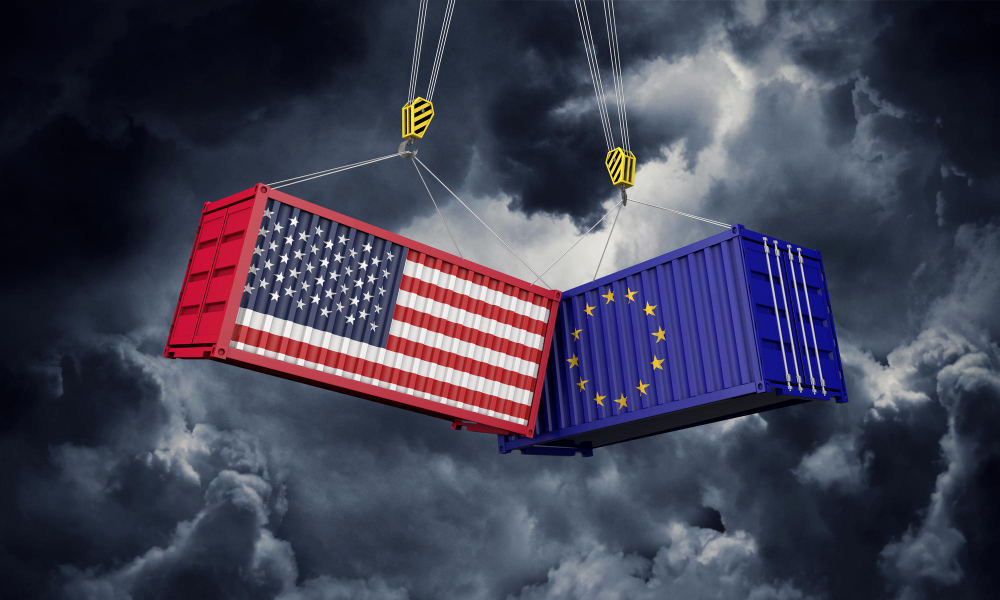
The Council today adopted its negotiating mandates on two regulations aimed at implementing the tariff-related aspects of the EU-US Joint Statement, agreed on 21 August 2025. This marks a major step towards implementing the joint statement, which should contribute to restoring stability and predictability in EU-US trade relations.
The first regulation concerns the adjustment of customs duties and granting tariff rate quotas for US industrial products and certain seafood and agricultural products, while the second regulation focuses on extending the duty suspension for imports of lobster and processed lobster.
Regulation on customs duties and tariff quotas for US products
This regulation eliminates remaining customs duties on US industrial goods and grants preferential market access including via tariff rate quotas (TRQs) and reduced tariffs for certain US seafood and non-sensitive agricultural products.
While largely supporting the Commission’s proposal, the Council introduced key amendments to strengthen the economic oversight and protection of sensitive EU sectors.
The Council’s mandate calls on the Commission to continuously monitor the economic effects of the trade liberalisation measures on the EU’s economy and to submit a report on the regulation’s implementation and economic impact to the European Parliament and the Council by 31 December 2028.
The Council included a strengthened bilateral safeguard mechanism. This provides the EU with the necessary tools to address potential significant increases in imports or serious injury to domestic producers that may result from the new tariff concessions and TRQs.
The Council’s mandate also clarifies the provision concerning rules of origin, which should facilitate the implementation of the regulation.
Regulation on non-application of customs duties on lobster
This regulation, which focuses on lobster imports, provides for the continued non-application of customs duties on imports of certain types of live and frozen lobster. For these products, tariffs were already eliminated in December 2020 for a five-year period, until July 2025. It also expands the scope of the duty suspension to include processed (that is, prepared) lobster. The Council agreed to maintain the Commission’s proposal without amendments.
Next steps
With the adoption of these mandates, the Council is ready to begin interinstitutional negotiations (trilogues) with the European Parliament, with a view to reaching a final agreement on both texts.
Background
The European Union and the United States have the largest bilateral trade and investment relationship and the most integrated economic relationship in the world, representing almost 30% of global trade in goods and services and 43% of global GDP. EU-US trade in goods and services has doubled over the last decade, amounting to around €1,7 trillion in 2024. This deep and comprehensive partnership is underpinned by mutual investment: in 2023, EU and US firms invested over €4.7 trillion worth in each other’s markets.
The two regulations constitute the implementation of the commitments made by the EU under paragraph 1 of the EU-US joint statement, which was issued on 21 August 2025. This framework seeks to secure reciprocal tariff adjustments and is part of a broader effort to reduce trade tensions, improve economic cooperation and enhance market access opportunities for operators on both sides of the Atlantic.
To fulfil its tariff-related commitments under the joint statement, the US administration issued executive orders applying the 15% ‘all-inclusive’ tariff ceiling; reduction of ‘Section 232’ tariffs (from 27,5% to 15%) for EU cars and car parts (applied retroactively from 1 August 2025); exemptions from 15% tariffs for some key EU products, including aircraft and aircraft parts and generic pharmaceuticals; and the application of 15% “Section 232” tariffs on timber, lumber and their derivative products.
