
Speech by President von der Leyen at the European Parliament plenary debate on ‘High time to deliver on the Single Market, providing certainty and predictability for EU businesses and quality jobs’
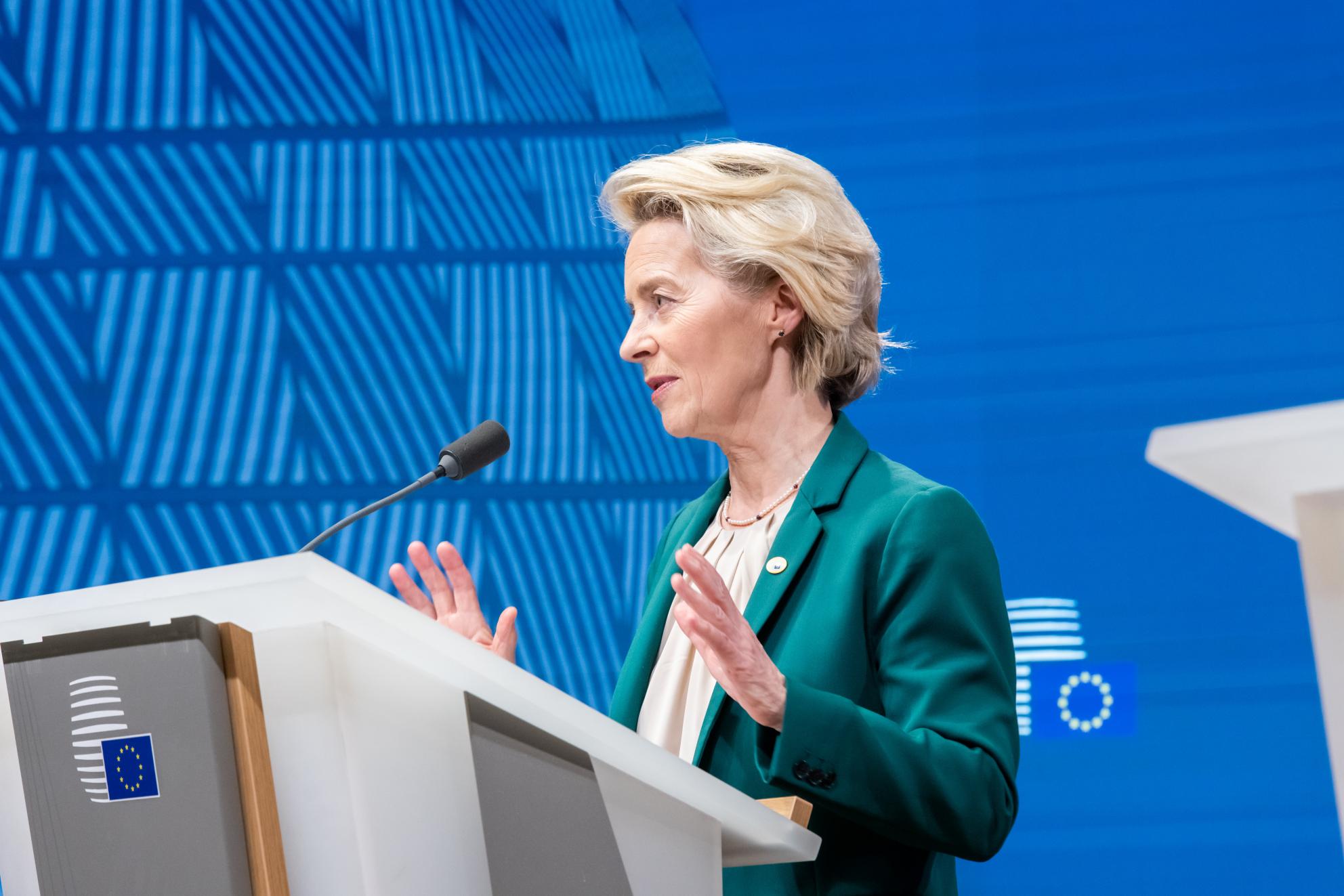 © European Union
 Good morning to all of you,
You have chosen the Single Market as central debate topic today – that is very good. Our Single Market is more than a continental marketplace; it is a cornerstone of who we are as Europeans. It binds our citizens, our businesses and our values together. The free movement of goods, services, capital and people. It has delivered decades of growth, jobs and opportunities. It has created better choices for consumers, larger markets for businesses and higher standards across our Union. And the Single Market remains our most effective tool, not only for prosperity but also for strategic influence. Because with 450 million people and a market of EUR 18 trillion, Europe has the power to set global standards. But – and this is the reason why we are debating here today – at times of restless technological change, climate urgency and geopolitical competition, just preserving the Single Market as we know is not enough. It can only remain fit for purpose if we modernise it, complete it and adapt it to the challenges of today. So today, I want to focus on six points.
First of all, we must finish what we started. We must remove the barriers that still persist in our Single Market. At the European level, we are addressing this with the ‘Terrible Ten’ proposal and with EU Inc. – a single set of rules that applies all across Europe. And at the national level, we have to crack down on gold-plating across the Union. We must make it easier to scale up across Europe. This is the basic promise of the Single Market, and it must be fulfilled.
Second, the Single Market must be digital by design. And the next phase of innovation will be defined by how digital capabilities are applied in the real world. Technologies like AI must be connected to the physical systems they are meant to improve. The good news is Europe has a good starting point. We have global industrial leaders as well as a growing start-up and scale-up scene. We have scientific excellence and a highly skilled workforce. What we need now is to create an environment that stimulates the demand for European digital solutions here at home. Then, we need projects of strategic importance – that are backed by credible business cases – and we need new tech champions in Europe. We have taken important first steps in this direction already. Three years ago, we launched the Chips Act. Since then, it has unlocked more than EUR 32 billion in semiconductor investments across Europe. We must build on that success. This is why we will present a Chips Act 2.0 – to strengthen Europe’s role in the semiconductor value chain. We will also bring forward a Cloud and AI Development Act – to support the growth of a strong AI ecosystem. And in summer, we will open the call for the first AI Gigafactories. So, the aim is to turn the scale of the Single Market into an asset in the AI race.
Third, sustainability must be baked into our market rules. We have our climate objectives and we have our circular objectives. They require a Single Market that incentivises clean innovation and, of course, eliminates barriers to trade in low-carbon goods and services. That is why, with the Industrial Accelerator Act, we are creating lead markets for clean products across our Union. These are basically the industries of the future, so we have to leverage our Single Market to create scale for exactly those industries of the future.
My fourth point is about European independence. You know that we are working hard on Europe’s independence – and the Single Market must help bring this to life. Since the pandemic, our companies have faced a long series of supply chain disruptions. Our Single Market can help. We must continue to leverage the scale to conclude new trade deals, for example. This year, we have concluded with India, Australia, Mercosur, Switzerland. Later today, I will head to Mexico where we will finalise our modernised global agreement, and Mexico is a key supplier for critical raw materials. And we can do more. For example, the Single Market can also facilitate the coordination of strategic investments and aggregate demand. Let me take the energy field for example. We proposed RESourceEU and created a new Critical Raw Materials Centre. Or take grids, the backbone of our energy system. We have one of the most extensive electricity networks in the world, but we need more coordination. That is what the Grids Package is about. That is now on your table. And in a few weeks, we will come with the Electrification Action Plan. All of this to build a stronger Single Market for a more independent Europe.
Fifth, inclusion matters. The benefits of the Single Market must reach every region and every citizen. Skilled workers must be able to move where their talent is needed – even if that is on the other side of the ‘non-existing’ internal borders. That is why we are putting together a Fair Labour Mobility package. We are introducing the European Social Security Pass, we are digitalising the recognition of professional qualifications, finally I must say. And we are strengthening the European Labour Authority to better enforce our fair mobility rules. I want to call on this House to take the next step: please adopt the e-declaration. The logic is very simple. We have one Europe. We have one portal. We have one form. It is ready. So please, let it be done. This will help talent flow where it is needed most, and it will protect workers’ dignity.
Sixth, the social dimension. Because our Single Market is not just about companies, it is about workers, it is about people. Jacques Delors used to say that the social dimension is ‘the precondition and the goal’ of the Single Market. And yes, this is still true today. It is the precondition for moving forward, and the social dimension is the goal of everything we are doing. This is why, two weeks ago, we adopted our first-ever anti-poverty strategy. It is to raise more people into the middle class and avoid backsliding. We will consult social partners on a new initiative to support people into work. And this initiative will have a strong focus on enabling parents to go back to work – especially single parents. Parents need jobs – but to take the job while having children, they need good childcare for their children. We already support this through the European Social Fund and Cohesion funds. For instance, we are investing EUR 1.3 billion in Poland for new childcare places, and we can enhance support under the next MFF. It is the most effective tool. For parents, a job is earning their own income and taking pride in their own skills. For the children, it is education through childcare, and it means inclusion – children need other children. So jobs and education are the best possible poverty prevention. So please, let us lean in – it is worth it. And when we talk about jobs, we must always talk about quality jobs. Quality jobs build the skilled workforce we are so famous for, and we need to compete globally, and they create a virtuous circle of greater productivity and better salaries. This is why we are working with social partners on the specifics of the future Quality Jobs Act. Quality jobs are good for workers, good for business, good for Europe, and they must be at the heart of a stronger Single Market.
Honourable Members,
The Single Market is one of Europe’s great success stories. But success is not something we inherit from previous generations. It requires constant work, vision and political will. And today, the political will is finally there with the ‘One Europe, One Market roadmap’. So let us get it done.
Thank you for your attention. And long live Europe.
