
We are delighted to invite you to a breakfast which will be held on Wednesday, 14th of October at 08.00 at the Member Salon of the European Parliament.
The event will consist of a debate on the potential of the Industrial Accelerator Act (IAA) across Europe’s downstream manufacturing sectors.
This event will be a timely opportunity to shed light on how to reinforce the Old Continent’s industrial resilience in the face of intensifying global competition, as well as on the challenge for policymakers to ensure that the legislation reflects the realities of Europe’s industrial value chains.
This event is kindly hosted by Pierre Jouvet MEP.
Speakers and further details will be announced in due course, however, we are publishing this event now to ensure you save the date.
Please kindly note that this event is by invitation only.

This event is organised in partnership with

About the debate
The proposed Industrial Accelerator Act (IAA) has marked an important step in the European Union’s renewed industrial strategy. Designed to foster both the competitiveness of European manufacturing and its decarbonisation processes, the IAA has set the target to increase EU internal production up to 20% of its GDP by 2035 by introducing “Made in EU” and low-carbon preferences into public procurement and support schemes, along with some conditions on foreign direct investment. It also aims at simplifying permitting and creating lead markets for low-carbon products in order to reinforce the old continent’s industrial resilience in the face of intensifying global competition.
In this context, much of the public debate has mainly focused on upstream sectors, while limited, or indirect, attention has been dedicated to downstream producers. However, the effectiveness of this new legislative initiative will also depend on its ability to support the entire industrial value chain. In fact, downstream manufacturing sectors occupy a central place in Europe’s industrial ecosystem, as they transform basic materials into high-value products, drive innovation, sustain skilled employment and underpin the competitiveness and sustainability of strategic industries such as automotive, agriculture and construction. Ensuring that these sectors remain globally competitive is therefore not only an industrial objective, but also a prerequisite for achieving the Clean Industrial Deal’s objectives.
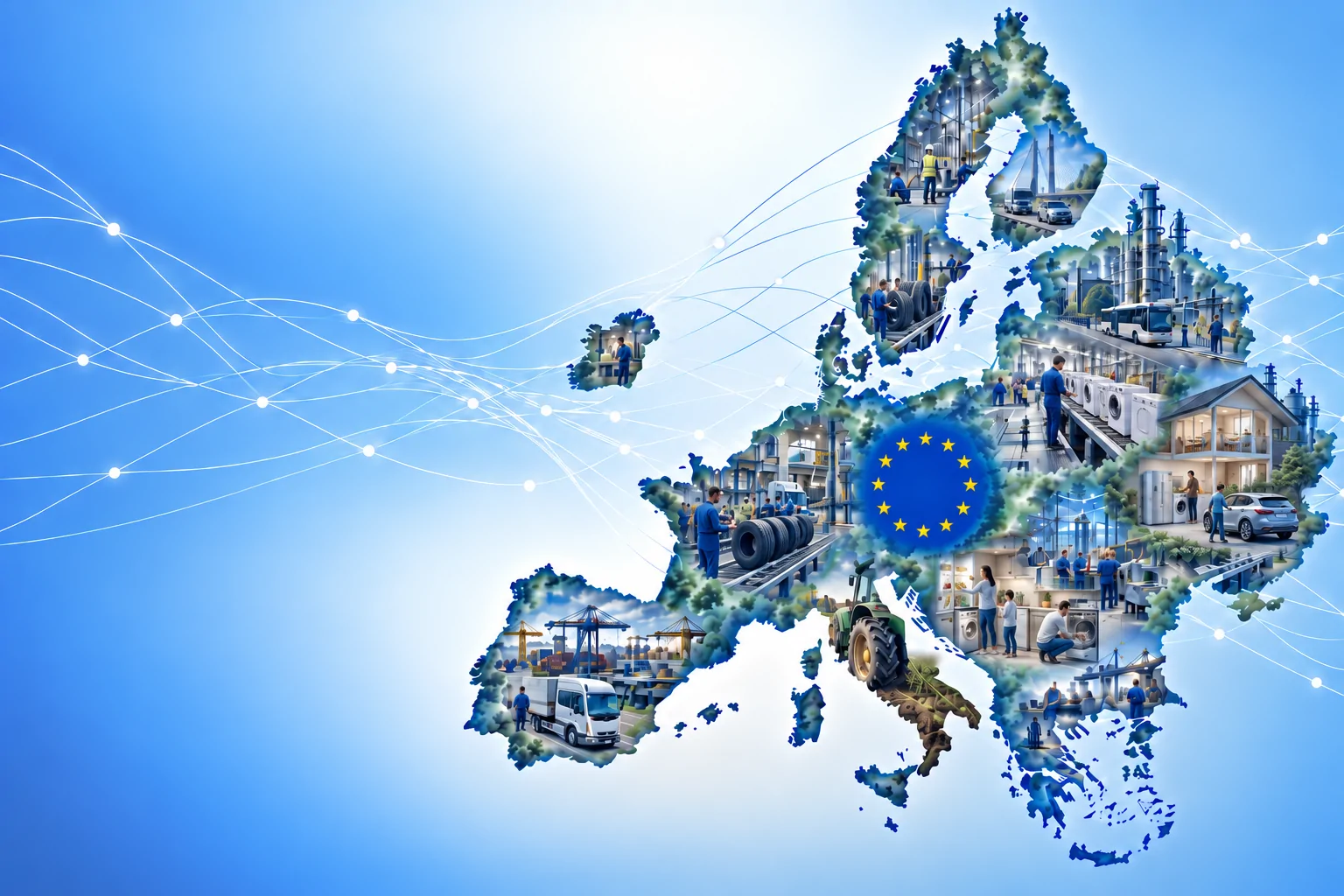
The European tyre industry provides a compelling example of why downstream sectors should receive greater attention within the Industrial Accelerator Act. EU-produced tyres contributes €43.9 billion to EU GDP supporting half a million jobs across the European Union. Additionally, they are strategic to passenger transport and logistics, as well as other critical sectors such as construction, defense and agriculture with an even larger estimated economic impact, supporting €572 billon in GDP and 6.1 million jobs. More broadly, tyre-dependent vehicles and equipment are essential enablers of economic activity, supply chains and public welfare.
Similarly, the European home appliance industry is both a major economic contributor and a key enabler of the green transition. The sector contributes €79.7 billion in added value to EU GDP and supports nearly one million jobs. At the same time, through increasingly energy-efficient and smart appliances, it helps households and businesses reduce energy and water consumption, lower costs and improve resource efficiency, making it an important driver of the EU’s sustainability and innovation objectives.
Despite their strategic relevance, the current IAA proposal provides only limited support for downstream sectors, as demand-side measures are constrained especially where European manufacturers face intense price competition from imported products, particularly from China. This omission risks limiting the Act’s ability to create meaningful lead markets for European-made tyres precisely where competitive pressures are the greatest. As one of the most trade-exposed automotive components, tyres illustrate the broader challenge of maintaining an EU industrial base while pursuing ambitious climate policies. Against this backdrop, some observers argue, the IAA could be strengthened through several targeted adjustments. These include extending demand-side measures, introducing a Union-origin framework that genuinely rewards manufacturing within Europe and integrates criteria that recognise the “Made in EU” added value without distorting the market.
As the institutional debate on the Industrial Accelerator Act continues, the challenge for policymakers will be to ensure that the legislation reflects the realities of Europe’s industrial value chains. Supporting upstream industries alone will most likely not be sufficient to strengthen European competitiveness and innovation. Downstream manufacturers demonstrate that industrial resilience, decarbonisation and strategic autonomy depend on reinforcing every link of the manufacturing ecosystem. A more balanced IAA would therefore not only help preserve high-value industrial capacity in Europe, but also maximise the contribution of downstream sectors to the EU’s long-term competitiveness and climate objectives.
Please note that the reception will start at 08.00, while the event will commence at 08.30 and will last until 09.30.
The discussion will take place in the Member Salon situated on the ground floor of the Altiero Spinelli building.
Please note that the room in which the event will take place will be communicated in due course.
