
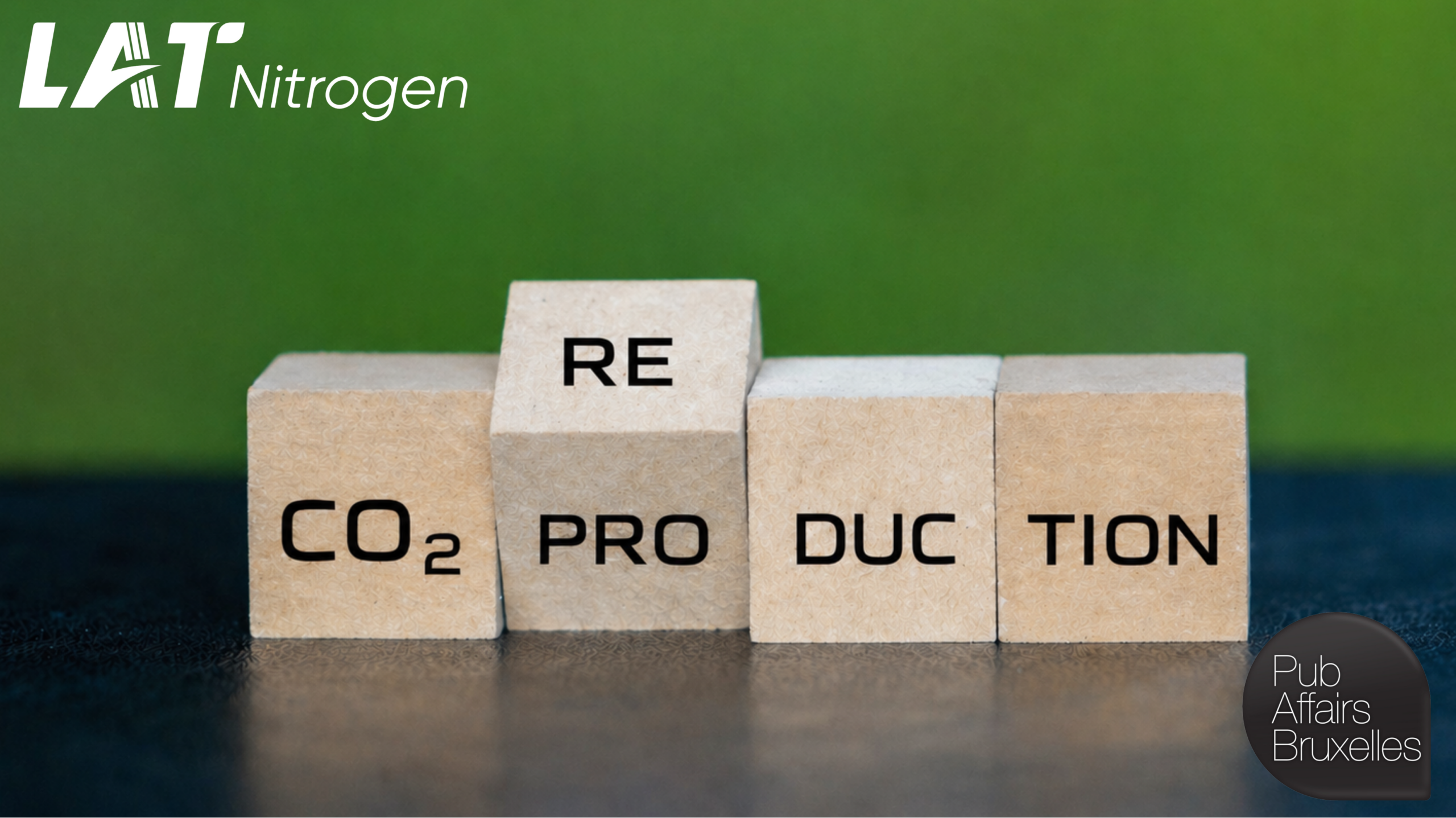
We are delighted to invite you to an in-person event which will be held on Tuesday, 23rd of June 2026 at 17.00.
The event will consist of an afternoon of discussion on whether the European Union can deliver on its climate objectives while sustaining a competitive, innovative and resilient industrial base. This event will also be a timely opportunity to discuss the implementation of the ETS and the entry to force of CBAM, as well as their implications on the competitiveness of the European industry, with our distinguished speakers:
- Tom Howes, Adviser, Green Transition and Market Regulation, European Commission;
- Bruno Tobback MEP (S&D/BE) ITRE;
- Michael Bloss MEP (Greens/DE) ENVI;
- Radan Kanev MEP (EPP/BG) ENVI;
- Klaus Hofstadler, Head of Energy and Operation Optimisation, LAT Nitrogen.
Leo Alders, Chief Executive Officer of LAT Nitrogen, will give a keynote speech.
Antoine Hoxha, Director General, Fertilizers Europe, will give the closing statements.
The discussion will be moderated by Kait Bolongaro, Managing Editor at MLex.
This event is public and will be held onsite.
Due to a limited number of seats, please await final confirmation from us after registration.

This event is organised in partnership with

About the debate
The European Union is entering a critical phase in the delivery of its climate ambitions. With the EU Emissions Trading System implemented and the entry into force of the Carbon Border Adjustment Mechanism, the European Union is moving from legislative design into a period of actual transition. These instruments are actively reshaping cost structures, investment decisions and competitive dynamics across Europe’s industrial base, whilst high energy prices and geopolitical shifts have led to a loss of competitiveness of several industrial sectors.
At the core of this transformation lie the crucial policy questions of creating a level playing field within the Single Market and the need to preserve the competitiveness of the European industry globally. Notably, the CBAM seeks to address carbon leakage by ensuring that imports bear a carbon cost equivalent to that faced by EU producers under the ETS. In doing so, it reinforces fairness within the EU market and beyond. However, this internal rebalancing does not extend to external markets when it comes to exports. European producers exporting to third countries continue to face carbon costs without equivalent compensation, raising concerns about their ability to compete globally and maintain market share. For sectors such as fertilisers, steel and chemicals – notably deeply integrated into international trade – this asymmetry is not theoretical, but immediate and structural.
This challenge is compounded by the evolving architecture of the ETS itself. The gradual phase-out of free allowances between 2026 and 2034 represents a shift towards full carbon cost internalisation. While this strengthens the carbon price signal and incentivises decarbonisation, it also increases direct cost exposure for energy-intensive industries. Companies are therefore navigating a dual pressure: on the one hand, the need to invest rapidly in low-carbon technologies, and on the other, the risk of cost increases outpacing their capacity to adapt, particularly in globally traded sectors with tight margins. Nevertheless, the question is no longer whether industry should decarbonise, but whether the pace and design of the transition are economically sustainable and technologically credible. Decarbonisation pathways are not uniform across sectors; for energy-intensive industries such as chemicals and fertilisers, for example, the transition depends on access to low-carbon feedstocks and affordable clean energy at scale. In this context, the deployment of low-carbon hydrogen remains constrained by current cost realities and infrastructure gaps. At the same time, the development of markets for low-carbon products remains insufficient to drive the necessary investment at the required speed. Targeted demand-side policies, including green public procurement and carbon contracts for difference, appear as possible options to bridge this gap.
At the same time, the implementation of CBAM introduces an additional layer of complexity. Despite the experience gained during the transitional phase, critical stakeholders continue to face uncertainty given the possible, retroactive derogations of sectors or exemption of countries from CBAM as well as challenges related to administrative burden, data availability and the treatment of complex value chains. Further, selective inclusion of downstream products, the risk of circumvention, and the overall coherence of the system persist. As a result, both CBAM and the ETS, although formally adopted, remain a living instrument subject to ongoing refinement and political negotiation within the Brussels policy ecosystem.
These regulatory developments cannot be considered in isolation from the broader industrial policy framework. The effectiveness of CBAM and the ETS will also depend on the availability of complementary measures capable of supporting industrial transformation. This includes access to finance, state aid flexibility, targeted support for breakthrough technologies and incentives to generate demand for low-carbon. Without such flanking policies, there is a risk that carbon pricing alone could lead not to decarbonisation within Europe, but to a relocation of industrial activity elsewhere, a scenario that would undermine both climate and economic objectives.
In addition, biomethane may deserve also attention in the debate on decarbonisation, as it could provide the chemical industry with a lower-carbon alternative to fossil-based feedstocks for certain processes, such as the production of ammonia, while also contributing to resilience and diversification of energy and input supply. However, its role depends on sustainable production methods, sufficient availability and the regulatory framework at a European level.
In such a context, the EU’s approach carries an increasingly significant geopolitical dimension beyond energy costs. By linking climate ambition with trade policy, CBAM positions the Union as a global standard-setter, encouraging partners to adopt comparable carbon pricing mechanisms.
Against this backdrop, the debate on CBAM and the ETS is no longer confined to technical design or sectoral impact. It goes to the heart of the European project: whether the European Union can deliver on its climate objectives while sustaining a competitive, innovative and resilient industrial base. The answer will shape not only the future of European industry, but also the credibility of the EU’s transition towards a climate-neutral economy.

This is a public event, hence the Chatham House Rule will not apply.
The event will start at 17.00 while the onsite welcoming at the premises of Blankspace will begin at 16.30. The discussion will last around an hour and a half.
Due to a limited number of seats, please await final confirmation from us after registration.
The audience will be able to ask questions both in person and through sli.do #ETS
We look forward to hosting you on the 23rd of June 2026.
