
We are delighted to invite you to a hybrid event which will be held on Tuesday, 10th of November at 17.00.
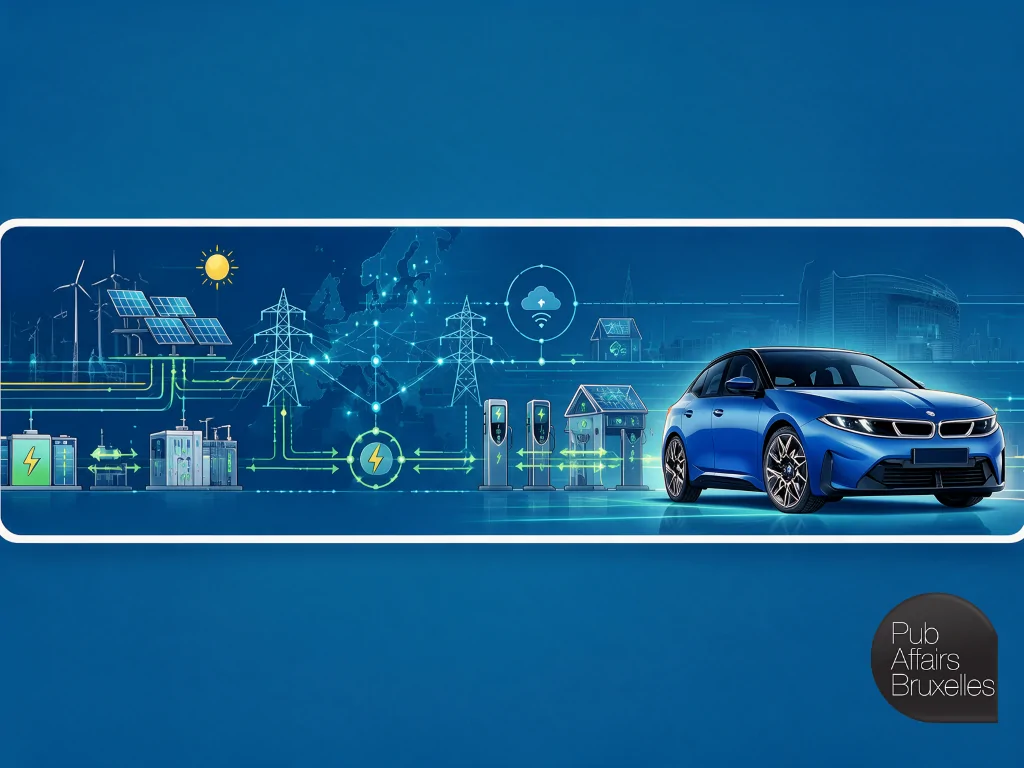
The event will consist of afternoon discussion on whether electric vehicles (EVs) can become a key asset for Europe’s power grid and the decarbonisation of the EU economy. This event will also provide a timely opportunity to discuss the challenges of establishing harmonised EU-wide rules and interoperable standards to ensure a seamless and reliable interaction of vehicles, charging infrastructure, digital systems and energy markets.
Speakers and further details will be announced in the coming days, however, we are publishing this event now to ensure you save the date.
This event is public and will be held both onsite and online.
Due to a limited number of seats, please await final confirmation from us after registration

This event is kindly supported by

About the debate
The European energy system is entering a new phase as the EU moves from accelerating renewable deployment towards integrating growing volumes of clean electricity. Transport is one of the domains at the centre of this shift, with electrification increasingly positioned as a pillar of the EU’s decarbonisation strategy. The European Green Deal, the Fit for 55 package, the revised Renewable Energy Directive and REPowerEU have established in the previous mandate the direction towards a more electrified and less fossil-fuel-dependent energy system. Yet the rapid growth of wind and solar is also increasing the need for flexibility, as renewable generation does not always coincide with electricity demand. This creates new opportunities for both the energy system and the transport sector to change the pace of the green transition.
As a result of these processes, the EU is increasing its efforts to expand clean energy generation, reinforce grids and accommodate growing demand not only from transport, but also across the wider economy and society. Against this backdrop, the European Commission has identified grid capacity, storage and demand-side flexibility as increasingly important aspects in its 2025 guidance. The EU executive body has also estimated that spending around €730 billion could be required for distribution networks, whilst roughly €477 billion would be needed for transmission networks by 2040. As far as the transport sector is concerned, the Alternative Fuels Infrastructure Regulation (AFIR) is establishing a common framework for charging infrastructure, including requirements along the TEN-T network and provisions on accessibility, interoperability and transparency. Yet differences in charging infrastructure, electricity systems, prices, consumer choice, tax frameworks and financial incentives continue to represent a divide across member states.
Nonetheless, the role of electric vehicles (EVs) could increasingly extend beyond simply generating additional electricity demand as most vehicles remain parked for significant periods, thus creating potential for their batteries to provide flexibility when connected to the grid. Smart charging could shift demand towards periods of abundant renewable generation, whilst vehicle-to-grid technologies (V2G) and vehicle-to-home (V2H) could enable stored electricity to be fed back into the grid or households when required. At sufficient scale, electric vehicles could help manage demand peaks, absorb surplus renewable power and reduce pressure on networks. Electrification could therefore become not only an outcome of the energy transition, but also a tool for managing it.
With millions of electric vehicles, one of Europe’s largest decentralised storage pools is emerging. Whilst batteries are in place, bidirectional charging can transform them into a shared flexibility resource, integrating mobility, energy and digitalisation into a unified European system. This will enable Europe to make better use of renewable energy, enhance the resilience of its energy supply and strengthen its technological and energy sovereignty. To achieve this, continent-wide compatible rules and interoperable standards to ensure that vehicles, charging infrastructure, digital systems and energy markets interact reliably are required. At the same time, if customer benefit remains the core focus, bidirectional charging will only achieve widespread adoption if it is simple, intuitive and economically attractive to use. The vehicle should automatically provide flexibility without compromising its primary function, namely mobility. In light of this, the compelling question for Europe is no longer whether electric vehicles can become part of the energy system, but how quickly a scalable European market can emerge from which customers, industry and the energy system alike would collectively benefit.
Notwithstanding the numerous success stories and already established best practices, realising this potential will depend on both addressing significant infrastructural and regulatory differences across the European Union and fostering local, regional and pan-European cooperation. Renewable deployment, EV uptake, purchasing power and charging availability are primary examples of the challenges ahead. However, both V2G and V2H technologies would also require interoperable and bidirectional charging infrastructure, data-sharing and EU-wide aggregation arrangements.
The opportunity therefore extends beyond the electrification of transport itself. If the EU can align its energy, infrastructure and mobility policies while addressing differences between its member states, EV batteries could help integrate renewable generation and manage electricity demand, reducing some of the pressures created by electrification. The next phase of Europe’s energy policy may consequently be defined not simply by how much renewable energy or how many electric vehicles the EU can deploy, but rather by how effectively these assets can be integrated into a more flexible and resilient energy system.

This is a public event, hence the Chatham House Rule will not apply.
The event will start at 17.00 both onsite and online, while the onsite welcoming will begin at 16.30. The discussion will last around an hour and a half.
Due to a limited number of seats, please await final confirmation from us after registration, if you wish to attend this event onsite.
The audience will be able to ask questions both in person and through sli.do #EVPowerEU
