
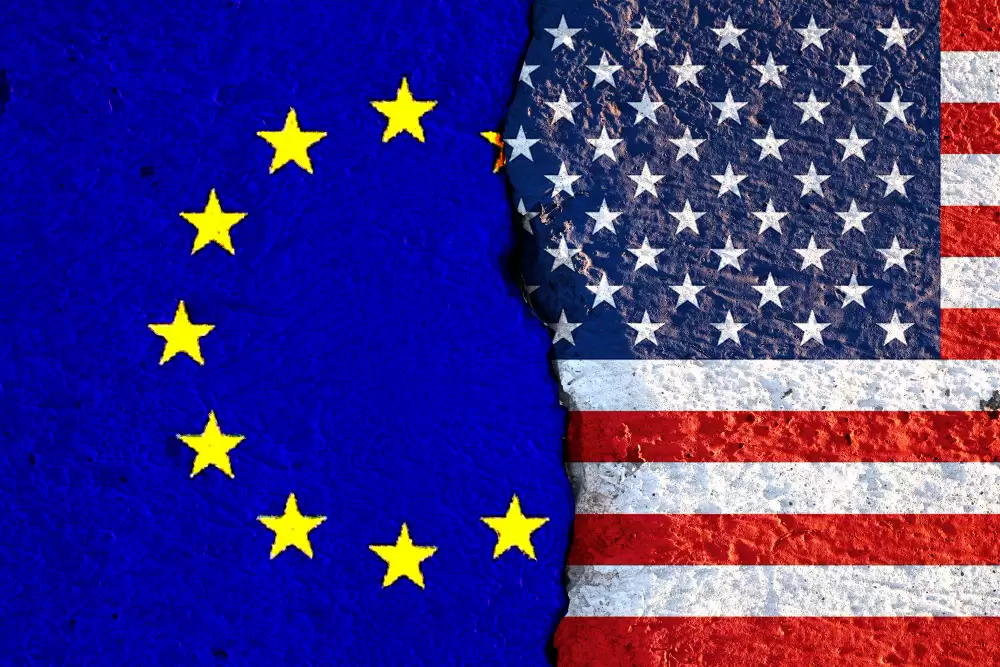

Many Europeans are hoping for a blue Congress after the US midterm elections. While this result would change the tone in Washington, it won’t change Trump’s policies.
A midterm scenario
It’s January 3rd 2027. In Washington DC, the newly elected Speaker of the US House of Representatives, Hakeem Jeffries, stands at the podium and delivers his acceptance speech. He promises to work with Senate majority leader Chuck Schumer to stop the war in Iran and reaffirm American support for Ukraine. He says he will end Donald Trump’s sweeping tariffs and curb the president’s corruption.
By summer, however, little of what Jeffries promised has materialised. Trump vetoes a war-powers resolution aimed at constraining the administration’s actions in Iran. The tariffs grow under the Lindsey O. Graham Sanctioning Russia and Iran Act. Congress appropriates funds for Ukraine’s defence and reconstruction; Trump signs the bill, then later kills the funds.
The House Oversight and House Foreign Affairs committees, both run by the Democrats, subpoena executives associated with companies tied to the Trump family: World Liberty Financial, 1789 Capital, Affinity Partners. But the White House claims executive privilege over any previous conversations between these executives and Trump, and they refuse to testify. The contempt-of-Congress referrals then die at the Justice Department.
Events come to a head in September 2027, when the Democrats, frustrated with their inability to restrain the president, threaten to withhold government funding. The White House retaliates by threatening to withhold supplemental food assistance for impoverished families. Jeffries is forced to decide whether he can risk culpability for starving American children.
In the above scenario, those Europeans who were hopeful that the midterms could offer change discovered that the Democrats could harass the president—but they could not stop him. While forecasts predict that the House of Representatives—and possibly the Senate—will turn blue on November 3rd, Europeans should not assume that Democrats can rein in Trump’s foreign policy.
A Democratic victory won’t stop Trump
Congress supposedly wields considerable power in foreign policy. It can declare war, appropriate funds for foreign affairs (including for the military), confirm nominations, regulate foreign commerce, ratify treaties and oversee the executive branch. Over the last century, these authorities have been blunted or ignored, so Congress today uses three main levers to exert power: must-pass appropriations legislation, regulating foreign commerce and executive oversight.
The Trump administration has spent the last two years eroding or routing around each of these. It cancelled funding approved by Congress and then ignored the subsequent outrage. Europeans should not mistake a Democratic Congress for one that is willing—or indeed able—to restore any semblance of a pre-Trump foreign policy. They should instead assume that America will continue with the same volatility and avoid becoming complacent in the event of a Democratic victory.
In July 2025, the Republican-controlled Congress passed a rescissions package of about $9bn, which cut funding for ongoing foreign-aid programmes. A month later, the White House used a “pocket rescission”—asking Congress to cut funds so close to the end of the fiscal year (on September 30th) that they expired before lawmakers could redirect them—to cancel an additional $4.9bn in foreign aid. Although the move was widely considered illegal, Trump has faced no consequences. The Supreme Court allowed the administration to withhold the funds when it first used the manoeuvre in 2025.
On September 25th 2026, the White House announced another pocket rescission of $810m, which was once again denounced—by the Government Accountability Office and leaders across both parties—as illegal. In practice, this means that a Democratic Congress could write money for Ukraine or development aid into law and the president might not spend it. Even lawsuits, the most viable obstacles to the Trump administration, would likely be resolved after the fiscal year ends and the money expires.
Congress can, alternatively, refuse to pass government funding bills, resulting in a government shutdown. But this move is politically costly: for example, during the 2025 shutdown, the administration declined to use a contingency fund to keep food assistance flowing and some 42 million Americans saw their food benefits lapse. Democrats had to decide between fighting the administration and risking worsening hunger, or dropping their demands over health care. In the end, some Democrats voted to fund the government.
This pattern of circumventing budget power should worry Europeans; the Democrats are unlikely to keep Trump in check during the rest of his term. The erosion of congressional leverage and US governing norms means America could be an unreliable partner for Europe beyond the Trump years.
No power over tariffs
Congress should have the power to regulate foreign commerce, create sanctions and set tariff rates, but the Graham act has given much of this to the White House. The act provides for tariffs of up to 100% on goods from the largest importers of Russian oil and gas, including liquefied natural gas and pipeline gas, putting Europe within its scope.
The act should incentivise countries to diversify away from Russian energy. However, it leaves key judgments—which countries qualify, what rate they pay and who can be spared US retaliation—to the president. Nothing prevents Trump from deciding that the proof of a good-faith effort to diversify is a contract with an American company. In effect, the act returns much of the discretionary tariff authority the Supreme Court took away in February 2026, when it ruled that the president could not impose tariffs under emergency powers.
Congress is unlikely to undo this act, since it passed with large majorities in both houses, and Trump will continue to use tariffs against Europeans with impunity. Europeans are especially vulnerable: this legislation covers countries with significant Russian energy imports. Trump has already shown his willingness to use all leverage against Europe.
Subpoenas met with silence
One of Congress’s strongest checks on presidential foreign policy is its power of oversight. But the Trump administration continues to disregard governing norms and protect Trump’s advisers. Europeans will have to continue dealing with corruption: for example, the Lukoil deal, or various Balkan property and energy projects. And Democratic members of Congress who have promised to hold the administration to account will be limited in their ability to do so, making trustworthy relations between American and European officials harder to build.
Trump has signalled that he will issue mass pardons before leaving office. Although a pardon does not excuse an official from testifying, other routes such as civil suits remain—but Congress does not control these. It can send contempt referrals to the US attorney for the District of Columbia, Jeanine Pirro, but as a Trump loyalist, she is unlikely to prosecute. Investigations by Congress can thus lay the groundwork for future consequences, but Congress alone offers little accountability.
Moreover, the administration is now protecting those who have never held office. On August 10th 2026, the Justice Department concluded that executive privilege covers conversations between the president and outside advisers, provided they concern official matters. Democrats had planned to subpoena these and other parties to overcome stonewalling and non-compliance. But now this route for oversight is narrowing, too.
This matters in foreign policy because so much of Trump’s diplomacy runs through people outside the West Wing. Jared Kushner, the president’s son-in-law, is part of negotiations on Gaza and Ukraine while running an investment firm backed by Gulf money. European leaders should not entertain this level of corruption, even when it puts them at a disadvantage—but they also need to recognise that such corruption is pervasive. They should work to disincentivise other countries from becoming embedded in these dealings, especially when they affect European interests.
How Europe can prepare
The midterms may change the tone in Washington, but they will not change the policy. As such, Europeans need to prepare for what comes after November 3rd—and what might happen in 2028.
First, Europeans should treat earmarked funds as intent, not commitment. Because the Trump administration is using pocket rescissions, Europeans cannot count on allocated funds until they are spent. This affects European plans that depend on US support for Ukraine, defence, and foreign aid. European planners must budget on the assumption that America can cancel such funds at any time. Democrats are unlikely to secure funding for their priorities, especially those related to foreign policy, and Europeans should assume that promises made by Democrats are not reliable.
Second, European leaders should prepare for Trump to use the Graham act against them, and accelerate their own phase-out of Russian energy where they can. The act is nominally narrow in scope, but leaves much judgment to Trump, meaning that countries importing any Russian energy should prepare for him to use tariffs as leverage. EU officials should plan retaliatory economic packages on the assumption that Trump’s tariffs will persist or increase.
Third, Europeans should use Congress for information, not protection. A Congress run by Democrats could expose Trump’s volatile foreign policy, including his corrupt dealings close to European shores. This may allow European leaders to build a case for exerting more leverage against the US, and to find officials in the Trump administration with shared priorities. But European leaders should not treat any promises or reassurances from members of Congress, however sincere, as guarantees.
The US administration is proving remarkably resistant to America’s system of checks and balances. Nowhere is this clearer than in Trump’s foreign policy. Europeans have a clear view on his vitriol and volatility, and are understandably pinning their hopes on the Democrats to constrain him. But those hoping that a midterm Democratic win will lead to a powerful blue Congress are mistaken. Europeans should instead use any leverage they have to plan for an even more volatile America during Trump’s final two years.
About the Author:
Nevada Joan Lee is a policy fellow at the European Council on Foreign Relations, based in the Washington office. Her research focuses on European security and defence, US foreign policy, the transatlantic relationship and NATO.