
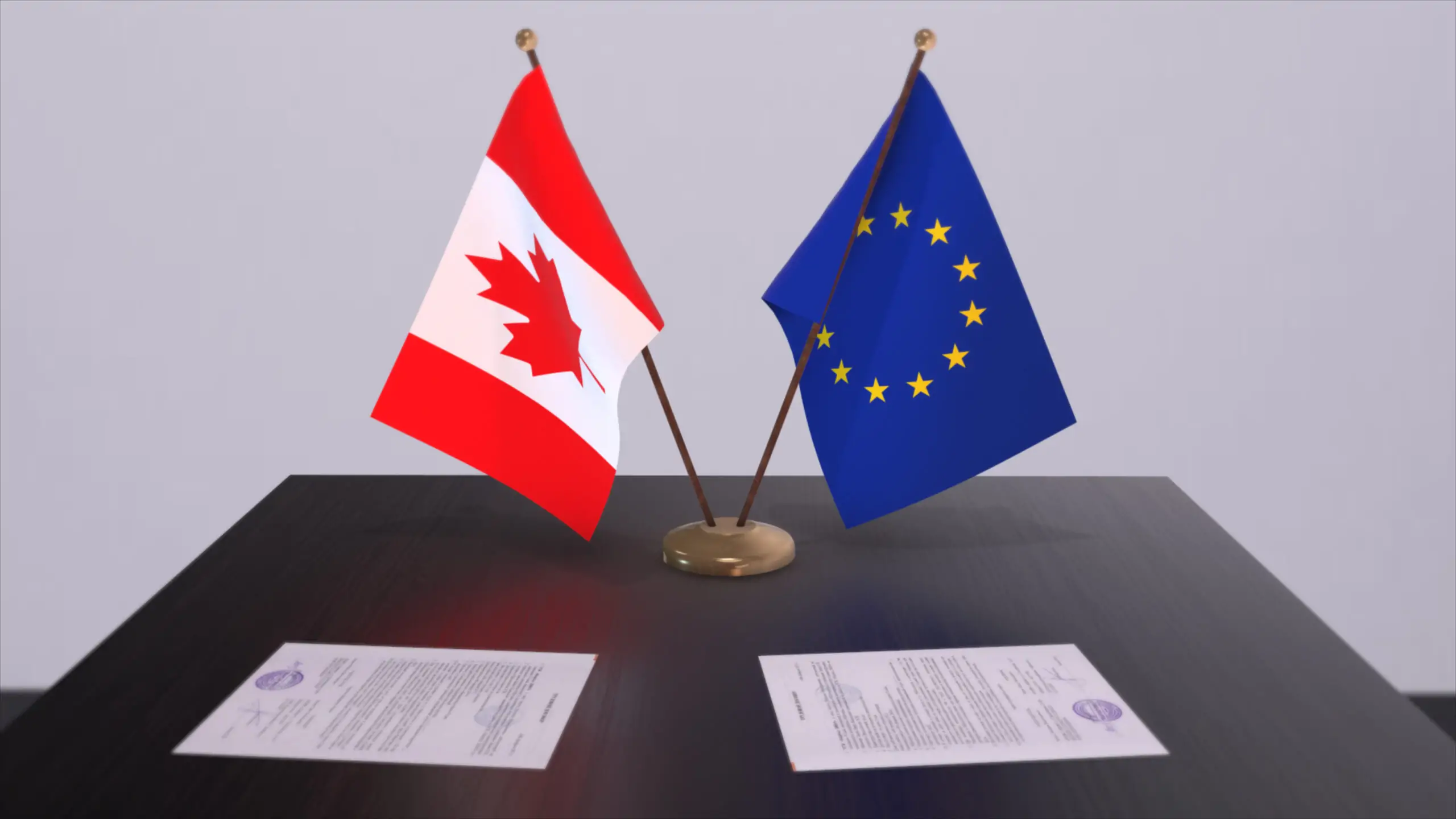
During her State of the Union Address on 16 September 2026, Ursula von der Leyen, President of the European Commission, invited Canada to become the EU’ s first-ever associate member (von der Leyen, 2026, p. 8). This proposed status is predicated on the EU and Canada’ s shared democratic values and similar approaches to major international issues (Rankin & Cecco, 2026). At the moment, the offer stands as merely an invitation; if developed further, it could deepen the EU-Canada partnership and contribute to gains in European security (Rankin & Cecco, 2026).
The proposal comes amid increasing geopolitical instability, a rapidly changing global security environment, and pre-existing defence cooperation between the EU and Canada. The war in Ukraine, Russian hybrid warfare on NATO’s territory, US isolationism, great-power competition, and the emergence of disruptive technologies have driven Europe to strengthen its own defence capabilities while reducing its dependency on the US (Csernatoni & Stone, 2025, pp. 9-11; European External Action Service [EEAS], 2025; Grey et al., 2026).
Meanwhile, tensions between Canada and the US have escalated during US President Trump’s second term, with tariffs and threats of annexation (Csernatoni & Stone, 2025, p. 9). Following President Trump’s escalation of his trade war with Canada in September 2026, Canadian Prime Minister Carney (2026) spoke of preserving independence and building partnerships based on shared values, echoing EU priorities.
The Development
Von der Leyen’s proposal for Canada’s associate membership was framed in light of democracy, the rules-based international order, and securing European interests in the face of complex threats through reimagined partnerships (von der Leyen, 2026, p. 8). She emphasised that this proposal is “not a partnership against anyone else, but for our common strength” (von der Leyen, 2026, p. 8), highlighting the EU’s shift towards strategic interdependence (Aydıntaşbaş et al., 2023). Prime Minister Carney echoed these statements in his speech to the European Parliament the following day (Carney, 2026).
“Associate member” does not currently exist as a legal status under EU law, and von der Leyen did not provide details on how this might look in practice during her address (Walker & Beake, 2026). However, defence, artificial intelligence, energy, critical materials, and economic security were outlined as key areas for EU-Canada cooperation (von der Leyen, 2026). Of particular significance for European militaries, von der Leyen (2026) named the integration of defence industrial bases and making the Arctic a “flagship joint project” as central components of the potential partnership (p. 8).
The EU and Canada have already taken steps to increase collaboration on security and defence matters. On 23 June 2025, they signed a Security and Defence Partnership, deepening defence ties and reflecting their commitment to global security cooperation grounded in international law (EEAS, 2025). Canada also became the first non-European country to participate in the Security Action for Europe (SAFE) programme, signing an agreement on 14 February 2026 (European Council, 2026). Furthermore, Canada has long been an active participant in the EU’s Common Security and Defence Policy (CSDP) and in Permanent Structured Cooperation (PESCO) projects on Military Mobility and Network of Logistics Hubs in Europe and Support to Operations (Government of Canada, 2025).
Significance
The full significance of this development depends on what associate membership status looks like in practice. While an EU-Canada defence relationship already exists, the real change that associate membership could bring is the potential to transform it from one of cooperation to one of integration.
Integrating Canada deeper into the EU could facilitate interoperability through more systematic
cooperation, military mobility, the exchange of information on defence issues, and logistics (Csernatoni & Stone, 2025, pp. 8, 10). Furthermore, by integrating Canada into the EU’s defence architecture, Europe diversifies its defence capabilities and resilience against modern threats. Canada brings unique technological expertise in the AI, cyber, space, and Arctic domains (Csernatoni & Stone, 2025, p. 5). This expertise, combined with European scale and funding, could further the
development of advanced military technology in cyber-defence and drone systems (Csernatoni & Stone, 2025, pp. 5, 8). Moreover, other outlined focuses of the partnership, such as collaboration on energy, economic security, and critical materials (von der Leyen, 2026, p. 8), may help strengthen European multidimensional security in an environment facing increasingly varied threats.
At the geopolitical level, Canada’s potential integration into the EU’ s defence architecture diversifies Europe’s strategic partnerships by reducing its reliance on a single external partner (Csernatoni & Stone, 2025, pp. 5, 8). This is particularly relevant amidst uncertainty surrounding the future role of the US in Europe’s security. A strengthened relationship with Canada, both bilaterally and within NATO, broadens transatlantic resilience against US isolationism and economic threats (Csernatoni & Stone, 2025, p. 8).
However, deeper Canadian integration into EU defence also raises questions about the relationship between EU and NATO structures. Depending on how associate membership is defined, closer Canadian participation in the EU’s defence architecture, alongside its established role within NATO (Government of Canada, 2026), could create areas of overlap. Existing EU-Canada defence cooperation is intended to complement EU-NATO cooperation and rests on the assumption that NATO serves as the foundation of collective defence (Government of Canada, 2025). It remains to be
seen whether associate membership would follow
this established approach or lead to greater overlap
between NATO and EU structures.
What to Watch
While Canada’s status as the first-ever associate member of the EU is currently a proposal, the next EU-Canada summit, scheduled for 29-30 October 2026 (European Council, n.d.), will provide an opportunity to clarify how the proposed status could take shape. Of particular relevance to European defence will be whether discussions translate into deeper Canadian integration in the EU’s defence architecture, and how collaboration across other strategic areas develops to address increasingly interconnected security challenges.
About the author:
Luna Lampikoski is editor manager at Finabel, contributing to research on European security and defence issues.