
The European Union needs more money if it is to meet mounting budgetary obligations related to the green transition, competitiveness, foreign policy and repayment of debt from the NextGenerationEU post-pandemic recovery fund. To do all of this, an additional 0.9% of gross national income (GNI) in EU-level spending will be essential* – representing a near doubling of the EU budget as a share of GNI.
But the EU lacks tax-raising powers and its direct revenues (eg fines for EU law breaches) are limited. Nearly all EU revenue is collected by national authorities and originates from national budgets. To boost revenues, therefore, countries can either pay more in based on their gross national incomes (GNI), or agree new revenue-raising mechanisms. The choice of the mix of new revenues is significant because it changes the cross-country distribution of EU budget contributions, since the shares of the 27 members in any new EU budget revenue source will likely differ from their shares of GNI.
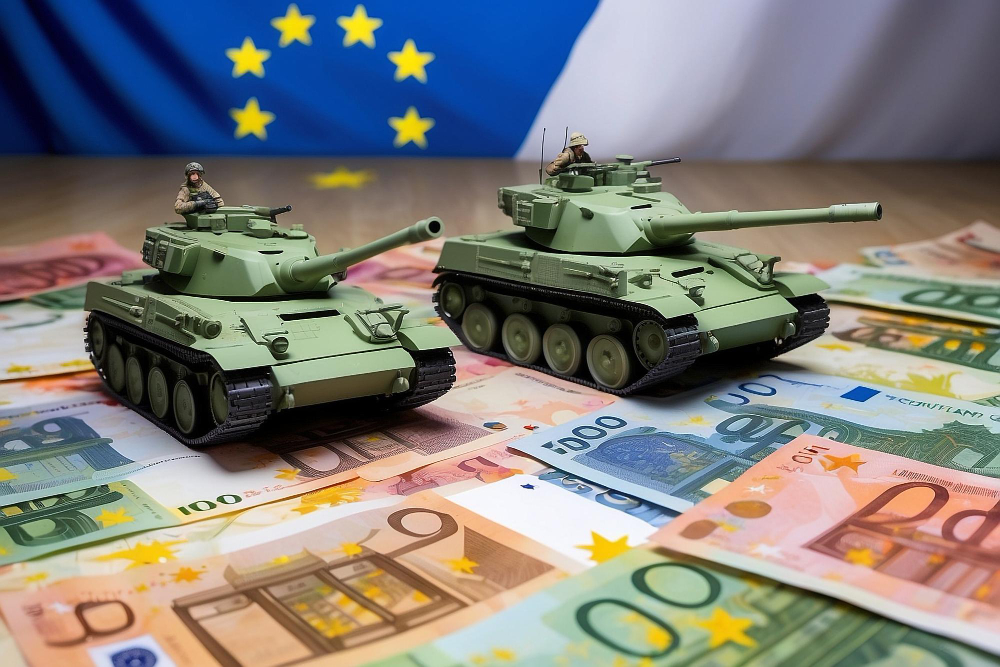
In this context, we recommend a new EU budget resource that would address an imbalance in national defence spending and incentivise low-spenders to spend more. Peace and security are vital for all of Europe, but are ensured through national defence and military spending. In 2023, defence spending ranged from just 0.2% of GDP in Ireland to 3.1% in Latvia. This variance creates a free-rider problem: countries spending less effectively benefit from higher spending elsewhere. The European public good character of peace and security would justify channelling revenues related to defence underspending to the EU budget.
An EU ‘defence spending shortfall levy’ could be calculated on the basis of national underspending in defence, using one or more indicators. A straightforward option would be national defence spending as a share of GDP compared to a benchmark, such as the EU average or a fixed value (eg 2% or 3% of GDP). Countries spending more would not contribute; only those spending less would. The chosen call rate – the percentage applied to the shortfall from the threshold – would affect how much of an incentive the levy would be for low-spending countries to raise their defence budgets, and how much the levy would redistribute the financing of the EU budget from high-spending countries to low-spending countries.
As an illustration, if the threshold was set at the EU average and the call rate at 25%, the 13 countries spending less than the EU average on defence in 2023 would contribute €8 billion annually to the EU budget. If the threshold was 2% of GDP with the same call rate, the 21 countries spending less than 2% of GDP on defence in 2023 would contribute €30 billion per year.
If a fixed threshold were applied, contributions would in principle cease once a specific defence spending value is reached (eg 2% or 3% of GDP), while a levy based on deviation from the EU average would continue to generate revenue indefinitely, as it is highly unlikely that all countries will spend exactly the same amount on defence and thus align precisely with the average.
The benchmark spending rate should not be interpreted as a uniform target for all countries. Optimal defence spending levels vary by country and depend on a range of factors, including geographic location. Rather, the benchmark rate should be viewed as an indicator discriminating between low and high defence spenders.
A complementary indicator could address defence procurement bias, penalising countries that unjustly favour domestic suppliers over suppliers from other EU countries (beyond an agreed threshold), and thus hindering the development of a European defence single market. This would incentivise cross-border procurement and strengthen defence integration.
The legal basis for the proposed levy would be Article 311 of the Treaty on the Functioning of the European Union, which underpins the rules on raising revenues for the EU (the Own Resources Decision). Like the non-recycled plastic waste levy, introduced as an EU budget resource in 2021, the defence spending shortfall levy would be calculated using statistical indicators, determining the size of each member state’s contribution to the EU budget. And like the plastic waste levy, which encourages recycling and has an environmental benefit, the defence levy would support an EU policy objective – in this case, stronger defence.
While politically sensitive, this new resource would underscore the EU’s commitment to collective security. It would also give EU countries an incentive to align with the common strategic objective of increasing the EU’s defence capabilities, while partially distributing the costs of European defence spending to those countries that spend relatively little.
* Authors’ calculation as detailed in a forthcoming Bruegel blueprint on the next Multiannual Financial Framework.
About the Authors
Armin Steinbach is a Non-resident Fellow at Bruegel as well as Jean Monnet Professor of Law and Economics at HEC Paris and Research Affiliate at the Max Planck Institute for Research on Collective Goods in Bonn.
Zsolt Darvas is a Senior Fellow at Bruegel and a part-time Senior Research Fellow at the Corvinus University of Budapest.
Roel Dom is a Research Fellow at Bruegel, as well as a visiting professor at the University of Antwerp.
Pascal Saint-Amans is a Non-resident Fellow at Bruegel.