
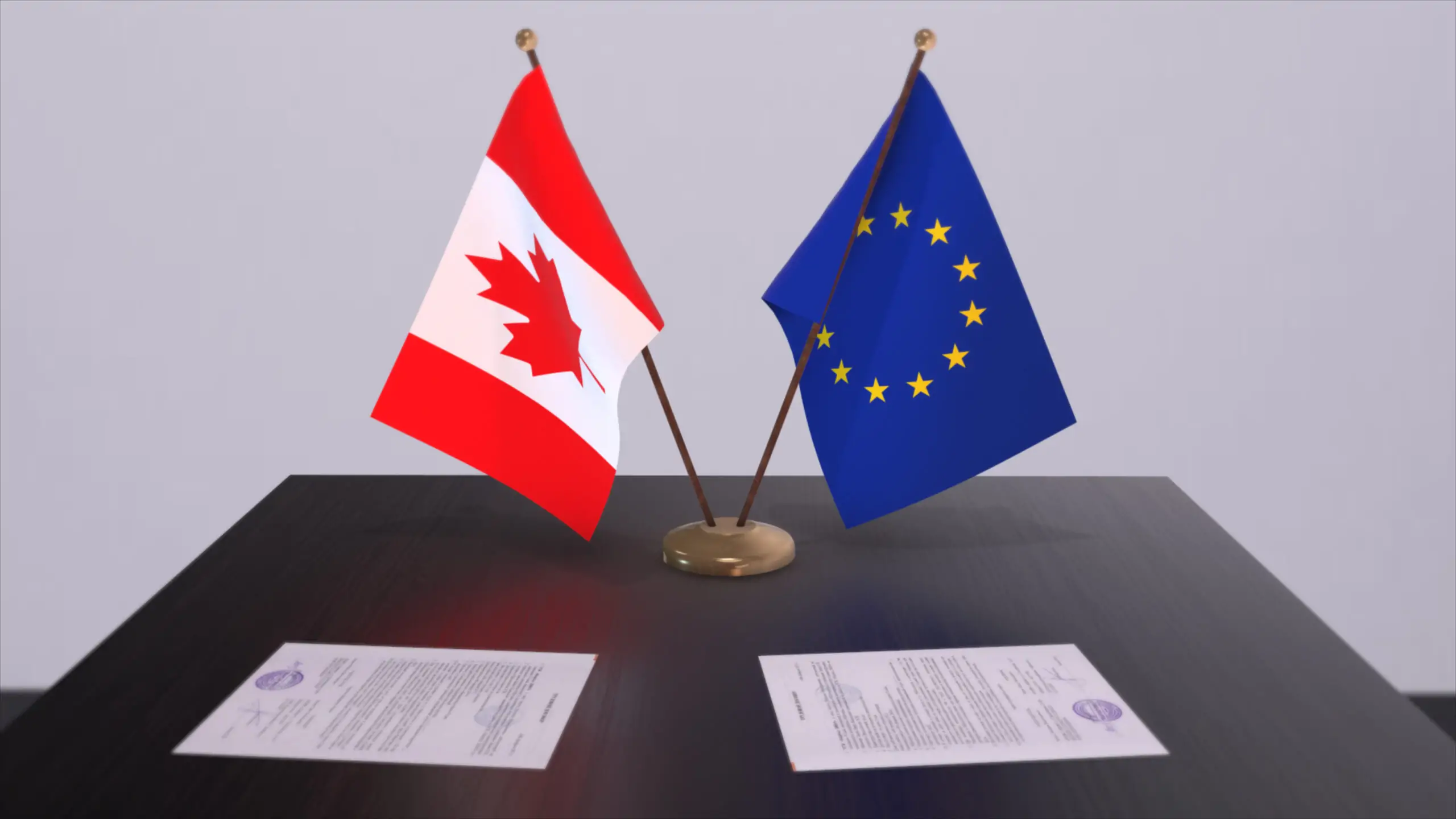
During his visit to the EU, Canadian Prime Minister Mark Carney made clear that Canada was seeking a ‘unique alliance’ with Europe. In her State of the Union address, European Commission President Ursula von der Leyen went a step further, calling for EU-Canada relations to be taken ‘to the highest level possible’ and giving this ambition a striking name: Canada as the EU’s first ‘associate member’.
While it made headlines, the term ‘associate membership’ doesn’t formally exist in the EU Treaties or in the EU’s enlargement framework.
More associate than member
Conventional EU membership would require Canada to submit a formal application, obtain candidate status and then embark on the demanding technical accession process, all of which would require the unanimous agreement of the EU Member States. Besides the enormous process of regulatory alignment with the EU that this entails, there’s a legal obstacle too, as the EU Treaties envisage EU membership for European countries only.
But anyway, full EU membership, and all the technical work that comes with it, might not be Canada’s best option – at least for now.
A second possibility would be deepening Canada’s economic integration within the EU’s Single Market, along the lines of the arrangements the EU has with EFTA countries. But this comes with a familiar trade-off: extensive alignment with EU legislation and Single Market rules without a formal say in the EU decision-making process.
The third possibility would be a genuinely new, values-based form of association designed for like-minded partners outside Europe. Rather than making access to the Single Market the defining feature, such a model could focus on areas where the EU and Canada already have strong strategic convergence, like foreign and security policy, defence, critical raw materials, energy security, digital and tech, research and innovation, and economic security. Prime Minister Carney has also pointed to easing the movement of people as an area for closer cooperation.
Such a model would allow Canada to meaningfully participate in some areas of the Single Market, and in certain EU policies, programmes and structures, including non-voting participation at Council meetings, building on Ukraine’s similar participation in areas of mutual interest. With this, Canada would be standing with the EU on critical issues – particularly foreign and security policy, where the EU could use more like-minded partners – without having to undertake the enormous task of aligning with the EU acquis.
In some ways, this would resemble the gradual integration already taking place with the EU’s current candidate countries. But it shouldn’t be considered as a shortcut. Canada could meet the Copenhagen criteria relatively swiftly, whereas the 10 candidate countries standing in line are facing a much more demanding process of political and economic transformation and regulatory alignment.
Actual EU membership is of course not on the table for Canada. What’s envisaged here is a new layer of structured integration for deeper association with like-minded partners. In a way, this would formalise the EU and Canada’s already close ties, while clearly distinguishing Canada from EU candidate countries.
The EU-Canada relationship is already closer than it looks
Canada is already much closer to the EU than the current talk of ‘associate membership’ might suggest. Economically, the EU is Canada’s second largest trade partner, and the relationship is underpinned by the Comprehensive Economic and Trade Agreement (CETA), although that still hasn’t been ratified by 10 EU Member States. Beyond trade, the two are increasingly cooperating on economic security, critical raw materials, digital trade, industrial policy and the green transition.
Politically, the EU and Canada have had a Strategic Partnership Agreement since 2017, setting up a political dialogue on a broad range of areas, including international peace and security, economic and sustainable development, justice, freedom and security.
The 2025 Security and Defence Partnership has also created a more structured framework for cooperating on issues ranging from support for Ukraine and maritime security to cybersecurity, hybrid threats, military mobility and crisis management. In defence, Canada is the first non-European country to participate in the Security Action for Europe (SAFE) instrument, that allows for investing in defence industrial production through common procurement. Canada also became the first non-European guest at the European Political Community summit in May 2026.
So, Canada has already broken the record by becoming the first non-European participant in a growing number of distinctly European instruments and political formats. Global geopolitical developments and US President Donald Trump’s continued threats are pushing the EU-Canada relationship even closer. The proposed status of associate member could therefore be seen not as a new relationship, but as an attempt to formalise a framework for increased Canadian participation in European matters.
A new model for like-minded partners
The upcoming EU-Canada Summit will show how this political concept could be translated into concrete substance. If ‘associate membership’ is to become more than a mere political slogan, the EU will need to lay down the areas, the rights and the obligations for taking the relationship to the highest possible level outside of conventional EU membership, and how that would fit within the existing Treaty framework.
The fact that the EU is experimenting with new ways of building deeper relationships with like-minded partners is a welcome development. Yet behind the slogans, this would be a powerful and pragmatic idea. Formalising the EU’s already close ties with Canada could allow for a new model of partnership that other like-minded countries may be interested in.
Ultimately, this could also pave the way for the broader case made by Carney in his now famous remarks at the Davos Forum in January, for building middle power coalitions. Such partnerships could extend well beyond the EU and Canada, and contribute to a much more resilient form of multilateralism in a highly uncertain world.
About the author:
Dr. Tinatin Akhvlediani is Head of the Enlargement Programme at the Centre for European Policy Studies (CEPS), where she specialises in EU enlargement and Eastern neighbourhood policies.