
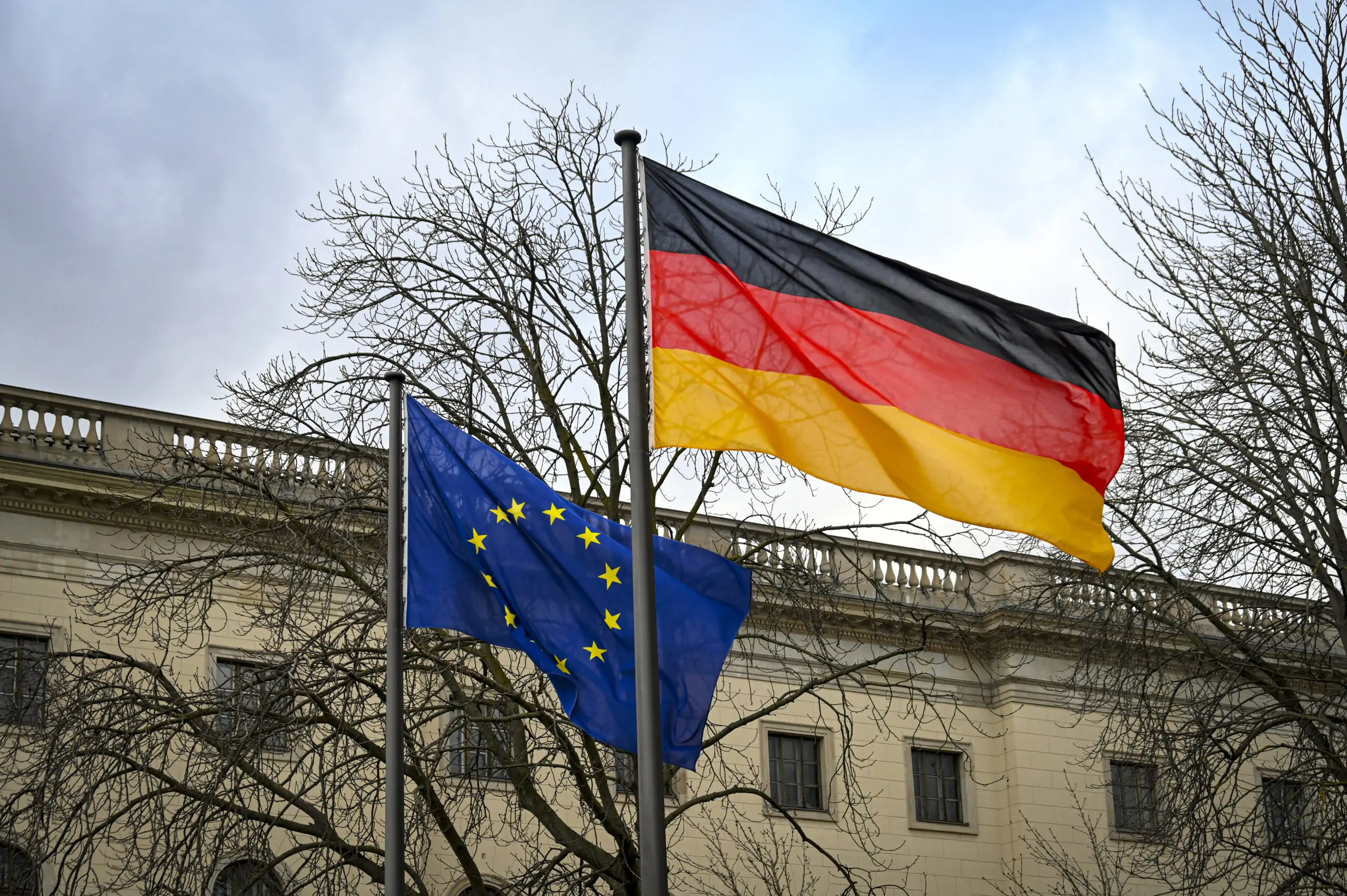
Rich. Stable. Boring. These were the conditions in Germany that laid the foundations for its role as Europe’s “benign hegemon” or “stabiliser”, as the country’s former finance minister Wolfgang Schäuble termed it. But they have eroded, and with them Germany’s sense of exceptionalism in the face of Europe’s crisis-ridden politics.
Just as the old German stability defined the country’s role in Europe, so too this new instability has begun to redefine it. Post-war German Europeanism was rooted in a sense of historical responsibility: the belief that Germany’s own security and prosperity depended on a peaceful, integrated continent. It translated into close engagement with the European project, an understanding of European integration as inseparable from the German national interest, and a willingness to compromise in pursuit of the common good. But a different approach may now be taking shape. Germany may increasingly define its national interests on their own terms, rather than through the European project, becoming less willing to shoulder the costs of European integration while expecting more in return.
This paper explores what might come next. It starts from the question: “What would it mean for Germany, and thus Europe, if at the next federal election the country voted in line with polling from late 2026?”
The paper argues that the Alternative for Germany (AfD) does not need to be in power for a different Germany to emerge. Indeed, it is already happening. After the next election, an even more fragile coalition may see a revolt by the right of the CDU/CSU and an emboldened AfD shaping political debates even more than it does today.
A more inward-looking political class could then find it becomes easier to say no to Europe than to lead it, as domestic concerns come to dominate Germany’s political agenda at the expense of its European leadership role. This would likely extend to the central position Germany plays in defence and security. Our concern is therefore not that Germany might dominate Europe, but rather that it might turn its back on the European project. Yet German exceptionalism always had an expiry date. The changes under way in German politics should thus compel the rest of Europe to cease clinging to the anchor state.
The new Bundestag we describe (the next election is due in 2029, though an earlier one is possible) is based exactly on the polling average at the time of publication. The analysis of what this could mean draws on extensive interviews with German politicians and thinkers, as well as desk research into polling data, party programmes, speeches and voting records. We decided to speak to figures in and around the AfD on the basis that engagement with the foreign policy outlook of a party now polling far ahead of the mainstream is necessary to understand the bigger picture.
To be clear, the paper makes no predictions. History is not linear. Germany has come through a series of searing challenges since unification, some of which have left their mark on the dynamics analysed in this paper. But the scenario is realistic, based as it is on observable trends and cautious assumptions about how they might develop. It is also far from being a “worst case” scenario for German democracy (which could yet see faster deindustrialisation, even faster-growing AfD support, a swifter and more total collapse of the firewall, and a shorter path to an AfD chancellor than the eventuality depicted here).
Much of what follows is therefore an attempt to trace where existing dynamics could lead. This makes the exercise a relevant and useful one not only for preparing for 2029, but also for understanding Germany now.
Deutschland divided
Until 2021, Germany’s economics and politics looked remarkably stable. The country relied on its traditional, if depleting, sources of strength: strong exports, social peace, security guaranteed by America, and the political leadership of a chancellor widely respected in society. Yet even in the long Merkel years, centrifugal forces were already at work. The population was ageing, with early signs of economic struggles beginning to appear in underinvested state infrastructure. And, although marginalised, populist voices were beginning to find more ears.
Now, it seems that Angela Merkel’s chancellorship marked the end of the old federal republic rather than its consolidation against the political and economic trends which will shape German politics in 2029 and beyond. If Germany continues on today’s trajectory, by 2029 it could end up struggling to make decisions, focusing inward and being more influenced by the far right than at any point in its modern incarnation.
Enduring political volatility
The harbingers
Olaf Scholz’s traffic-light coalition was an early sign of the troubles stalking German politics. It struggled with the legacy of Merkel’s “debt brake” and with Germany’s dependencies on Russia and China, which had solidified during her time as chancellor. Crucially, Scholz’s government also showed that three-party coalitions do not make for straightforward lawmaking, with infighting leading to its collapse in 2024.
The snap election in February 2025 brought together the Volksparteien under Merz in a coalition that was “grand” only in name. Together they won just 45% of the vote, translating to 328 seats in the Bundestag and a majority of 12. For comparison, when Merkel took office in 2005, 69% of Germans voted for the two parties (giving them 448 seats in parliament).
The CDU/CSU and SPD, already “big tent” parties, have become more ideologically and strategically disorientated as their support has plummeted. As of 2026 the SPD has spent 21 of the last 25 years in federal coalitions, mainly with its traditional rival the CDU/CSU. Fearing for their status, the parties strive to protect what is left of their political identities. This leaves less room for compromise on policy, whether pension reform, social security or tax, fuelling a public perception that the government is underperforming.
Such disillusionment has helped propel the AfD from a fringe party (which won only 10.3% in the federal election in 2021) to the second largest in the Bundestag today (and leading in the polls). Yet its hardline positions make it an outlier even among Europe’s other far-right parties, and it occupies a small, lonely corner of the European Parliament. German state intelligence services have categorised four of its five eastern branches as “right-wing extremist” and suspect the entire party may meet that description. Nevertheless, the AfD already shapes Germany’s political debates and actual policies: in January 2025, for example, a CDU/CSU motion to tighten migration policy passed with AfD support from opposition.
This was unprecedented, given that Germany’s mainstream parties refuse to cooperate with the AfD. But this “firewall” has come at a cost for the CDU/CSU especially, further eroding the CDU/CSU’s conservative image and allowing the AfD to claim it is the only credible representative of conservative voters.
Some conservatives, such as historian Andreas Rödder, now advocate “red lines” for potential cooperation with the AfD rather than a blanket refusal. Jens Spahn, the former head of the CDU/CSU parliamentary caucus, has said that there “would be no cooperation with this AfD”, which fuelled speculation around whether he would accept the party if it modified some of its most radical views. This position is gaining ground, particularly in the eastern states. If the AfD repeats in other states its feat in Saxony-Anhalt, where it came close to a majority and made forming a government against it almost impossible, some CDU lawmakers at state level may abandon the firewall. Signs of the pressure the firewall was under became visible in Saxony-Anhalt in October 2026 when a number of CDU politicians appeared to support the AfD candidate for the position of parliamentary speaker. Case-by-case cooperation in the states would pile yet more pressure on the CDU right to agree similar arrangements in the Bundestag.
These dynamics also play out in Germany’s 16 states, where significant executive powers sit within its federal system. Weak and minority regional governments would spell abstentions in the Bundesrat, Germany’s upper house and the voice of the state governments. And more power for the AfD in the states would also give the party more power in the Bundesrat. In the Saxony-Anhalt parliament, the AfD’s first proposal was to call for a Bundesrat initiative to end sanctions against, and normalise relations with, Russia.
The headlines
These trends are likely to shape the political aftermath of the 2029 election. If Germans were to vote in line with late-2026 polling, the Bundestag would fragment even more. The AfD would become the largest party, with no obvious or easy coalition options for the mainstream parties. Even in the unlikely event that the CDU/CSU abandoned the firewall, it would be too weak to lead a minority government that depended on floating support.
What remains is a “Kenya coalition” of all three mainstream parties (so called because their colours of black, red and green match that country’s national flag). This would be a marriage of convenience born out of a sense of responsibility and the need to keep the AfD out of power rather than shared interests or any common vision.
Such a coalition would be even broader ideologically than Scholz’s doomed traffic-light coalition and would start with much less goodwill. Passing budgets would be a particularly thorny challenge due to the partners’ divergent priorities in the realm of taxation, pensions and social policy. Coalition partners’ poor election showing would also deepen intra-party rifts, with the CDU/CSU’s right wing seeing the result as vindication of its reluctance to work with the centre left. The western and eastern party organisations would likely end up at loggerheads over the AfD, or reforms of the welfare system. The AfD’s new heft would make it noisier and better able to shift the terms of debate, exploiting divisions between and within the coalition partners.
Regionally and nationally, disquiet on the CDU/CSU’s right could prod it towards attempting to rebuild its conservative image through greater alignment with the AfD. To be sure, much would still separate the parties on the functioning of German democracy (the rule of law, judicial order and commemoration of the Nazi era), and on Western foreign and security policy totems such as support for Ukraine. But, besides migration, they may find common ground on tax cuts and deregulation as well as curbing EU costs and rules. They might also agree on opposition to “wokeism” and fears of left-wing extremism. And, though the AfD opposes European defence integration and is sceptical towards NATO, the parties are both supportive of Germany’s rearmament.
These conditions could lead to cracks in (or a breach of) the firewall, or at least elevate the voices already calling for its abandonment.
Endemic economic stagnation
The harbingers
Germany failed to use its boom years to embrace new (especially digital) technologies and invest in its productive capacity (or, as discussed, reduce its dependencies on Russia and China). Stagnation has plagued its economy since 2019. And even turning on the spending taps—Merz reformed the onerous debt brake in March 2025 to borrow for infrastructure and defence spending—has so far generated only a modest uptick in growth (estimated at 1.2% for 2026). Private consumption remains subdued as people hold onto their savings.
As the German economy has slowed, stagnation has intersected with, and exacerbated, the country’s fragmenting politics. It has pitted advocates of tax cuts against defenders of public investment and social security, and set up conflicts between rival visions for the country’s energy future, and for its pensions and healthcare systems.
The country is also deindustrialising rapidly. Germany weathered the “first China shock”, when Beijing flooded the European market with cheap textiles, electronics and other low-value goods. But now, China has risen up the value chain and, using aggressive currency and subsidy policies, it has generated a glut of high-value industrial goods, like cars, in which the German economy has long specialised. Beijing has also embraced technological advances that make brands such as BYD global leaders in electric vehicles.
In October 2026, the German and French governments proposed a “last resort” mechanism that would authorise the European Commission to restrict access to the European single market for companies from countries using economic coercion against the EU. Even if not spelled out, the main target of this new instrument would be China. But the Merz government’s support for such measures may have come too late to shore up Germany’s traditional industry, and the country’s producers will have to make up for their years of complacency about new technologies. At the time of writing, the country is, by some estimates, losing about 15,000 industrial jobs a month. Major German firms are also contemplating mass cuts: one leak from Volkswagen suggested several production sites could close, with a loss of up to 100,000 jobs.
Alongside its prosperity, Germany’s deindustrialisation is also a blow to its sense of self. The country’s society, culture and politics are structured around its old manufacturing giants and the Mittelstand of smaller firms that supply them (often deeply rooted in their local contexts). But the pride Germans felt at being Exportweltmeister (export world champions) has curdled into a prevailing gloom. Polling in September 2026 found that half of Germans are worried about their standard of living. This seems to have played a role in the Saxony-Anhalt election, with 86% of those who turned from the CDU to the AfD citing disappointment with politicians seemingly unable to solve the country’s problems.
The headlines
A second China shock could still define the Germany of the early 2030s, with the country’s industrial decline having proceeded significantly by the time of the next scheduled federal election. To turn it around, a Kenya coalition would need to overcome deep structural challenges—something that a strife-riven mainstream may by then be even less equipped to do. If the good economic times of the 2010s contributed to political harmony, continued stagnation could provoke greater disharmony in the future (and vice versa).
The far right will likely aim to exploit the gloom. When we asked one senior AfD politician about the pro-EU consensus among the German public, he referred to the “pocketbook theory”.[1] His argument was that German voters had been willing to tolerate the costs of EU membership while times were good, when they were confident that they would still be able to afford their house, their car and their holiday. But he said doubts about the future were prompting them to question the European status quo. At the very least, this points to an ambition on the part of the AfD to create a mandate for sweeping changes to Germany’s place in Europe and the world.
About the authors
Piotr Buras is head of the Warsaw office and a senior policy fellow at the European Council on Foreign Relations.
Jeremy Cliffe is editorial director and a senior policy fellow at the European Council on Foreign Relations.
Angela Mehrer is programme manager of the European Power programme at the European Council on Foreign Relations.
Jana Puglierin is head of the Berlin office and a senior policy fellow at the European Council on Foreign Relations.