
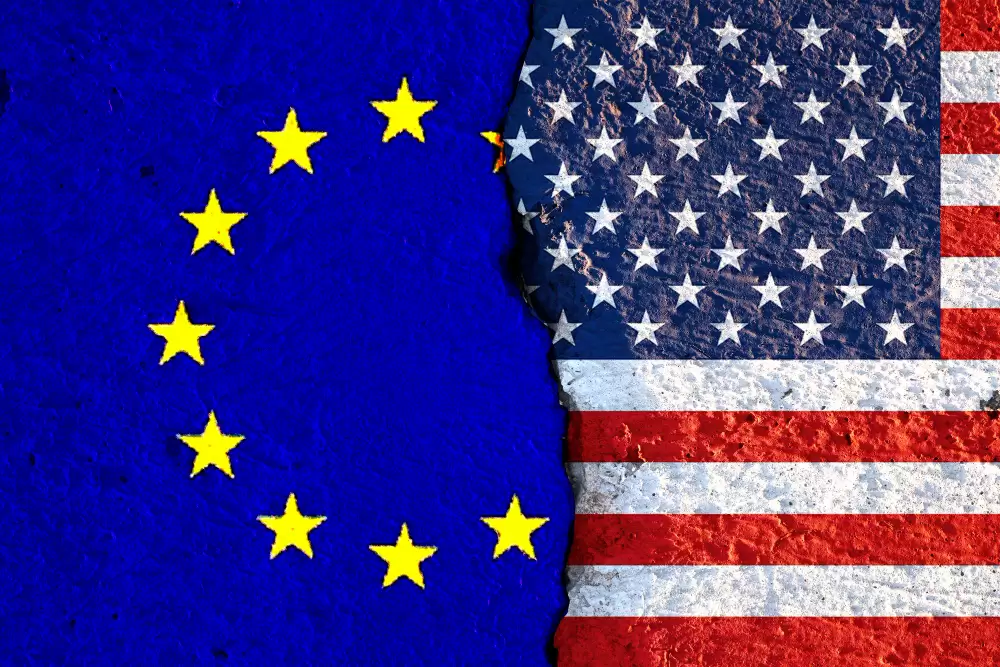

European exporters depend more on the US market than American exporters do on Europe, which means the EU is poorly positioned for a tit-for-tat tariff war with the US. But with targeted export tariffs, taxes on royalties, and the elimination of US Treasuries’ risk-free status, the EU could hit the US where it hurts.
Given that the US and the EU have the world’s most robust and important economic relationship, comprising not only high volumes of merchandise trade but also copious exchanges of services and capital, a transatlantic trade war would be very costly for both sides. But because European exporters depend more on the US market than American exporters do on Europe, the EU would probably have a harder time coping with escalating tit-for-tat tariffs, likely provoking resistance from the EU’s most exposed countries.
If, however, the EU eschewed import tariffs in favor of export taxes, the US may take a bigger hit. A large share of US exports to the EU is energy – a fungible commodity, for which alternative suppliers can be found relatively easily. By contrast, the thousands of goods for which the EU is America’s dominant supplier – amounting to $300 billion in annual US imports – would be significantly more difficult to substitute.
But the EU should go further. Instead of imposing blanket export tariffs, it should target those products for which the US has imposed no import tariffs – an indication of its desire to avoid domestic price increases. A good example is pharmaceutical products, where the EU runs a large trade surplus with the US. An even better example is the machinery used to manufacture microchips, especially the most advanced devices, produced by the Dutch company ASML. Without ASML’s machines, the US could not produce the chips it needs for AI technologies. This is why the firm has been exempted from US import tariffs.
Services represent another potential pressure point. Trump has so far concentrated on tariffs on goods. But the transatlantic services trade is almost as large as trade in goods – both a bit above $800 billion annually. And whereas the US has a deficit in goods vis-à-vis the EU, it enjoys a substantial surplus in services. The question is how the EU can exploit this vulnerability.
The obvious strategy, according to some, is a tariff on services imports from the US. But this would be difficult to implement, because the value of services traded directly across borders is hard to calculate. Others have proposed a European digital-services tax, because the costs would fall mainly on large US companies. But a number of EU member states already have such a tax in place, and it has had limited impact, while generating negligible revenues.
A better approach would focus on taxing royalty payments. The US owes its services surplus largely to royalty payments on technology patents – amounting to about €100 billion ($118 billion) annually – mostly from subsidiaries of large tech companies with headquarters in Ireland. For the US parent companies, this Irish address is vital to minimize their US tax liabilities. Closing this loophole would thus deal a direct blow to their bottom lines, and the US would have few options for retaliation.
But America’s largest vulnerability stems from its dependence on foreign investors to finance its massive deficit, projected to run at about 6% of GDP this year. This means that another $1.8 trillion will be added to the country’s existing debt of $38 trillion. European investors hold about $6 trillion of this debt – about $3 trillion in US Treasuries and another $3 trillion in Treasury-backed US housing-agency debt. The US holds only about half as much in European assets. Moreover, the EU runs a current-account surplus, so European governments do not depend on foreign buyers to finance their (much smaller) deficits.
This puts the US in a vulnerable position – and the Trump administration knows it. When a Deutsche Bank analyst suggested that European investors could sell off their US bonds and equities in response to Trump’s Greenland threats, US Treasury Secretary Scott Bessent downplayed the risk, while also warning Europe against such sales. Trump, for his part, promised “big retaliation” against any European country that sold US Treasuries.
But the notion that European investors could dump their US Treasury holdings, thereby bringing down the market and driving up interest rates, is unrealistic. While EU central banks hold some US debt, most of Europe’s US debt holdings are in the hands of private investors, especially financial institutions like banks and insurance companies. They are unlikely to heed calls to “sell America,” especially if it meant incurring large losses.
The EU does, however, have one option for exercising some leverage on this front: it can stop recognizing US government bonds as risk-free in its financial-market regulations. If European regulators were to assign even a small amount of risk to US government bonds, holding US assets would become more costly and less appealing for institutional investors. While any such change should be implemented gradually to limit losses for bondholders, the announcement alone would send a powerful message – and raise the cost of refinancing US deficits.
When Trump attempted to bully China with high import tariffs, China responded in kind, causing tariff rates to surpass 100% early last year. The EU would be unwise to replicate this approach, as emotionally satisfying as it might be. A more targeted strategy would hit the US where it hurts.

About the Author:
Daniel Gros is Director of the Institute for European Policymaking at Bocconi University.
Milan – Now that US President Donald Trump has climbed down from his demand to “own” Greenland, an imminent trade war between the United States and the European Union has been averted. But there is little reason to think that the Trump administration will not find more reasons to coerce and antagonize Europe, including with renewed tariff threats. But, contrary to the Trump administration’s narrative, EU leaders have options to push back.