
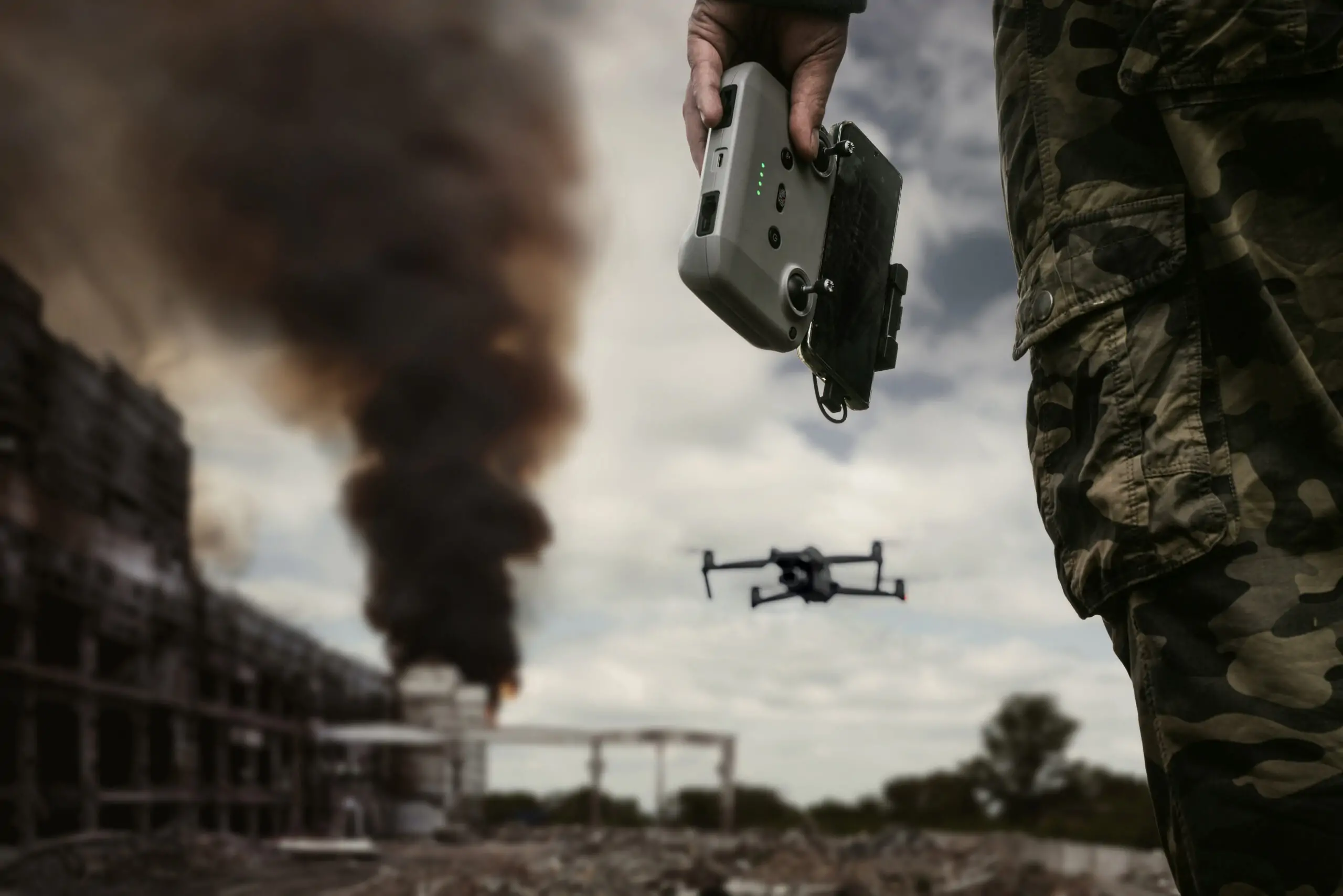

The NATO Summit in Ankara ended with a short but consequential declaration. Alongside commitments to develop a wide range of capabilities—such as drones, a warfighting cloud and AI models—the allies pledged to make them interoperable.
This is not a trivial statement. Weapons systems are becoming increasingly software-defined, and NATO standards need to keep pace. Interoperability would address a major problem of European armed forces: fragmented command-and-control systems that cannot easily share data. Yet the declaration also raises difficult questions. Interoperability requires common standards, and whoever defines these standards will control how allies operate and upgrade their militaries. Choosing the wrong architecture could replace one weakness with another.
Ukraine’s software edge
Russia’s war of aggression against Ukraine has demonstrated the importance of AI-assisted command-and-control systems. These are “systems of systems”, unified architectures that help aggregate and analyse vast amounts of battlefield data, thereby assisting in situational awareness, intelligence, mission planning and after-action review. Much commentary attributes Ukrainian battlefield progress in 2026 to certain drone models, underestimating the significance of Delta, Ukraine’s command-and-control system.
Compared to similar systems used by European armies, Delta offers significant advantages: it is the only one that provides a single digital architecture across the armed forces, integrating sensors, weapons and units regardless of the service branch or the system’s manufacturer. It can therefore rapidly coordinate different elements to achieve the desired effect on the battlefield, whether directing artillery and drone strikes, conducting air-defence operations or treating and evacuating casualties.
In contrast, EU militaries are much more fragmented. Different countries, and in many cases different service branches within the same country, operate different command-and-control systems, with limited interoperability. A French radar may be unable to exchange raw sensor data with an Israeli command-and-control system simply because they were built by different manufacturers and use different proprietary software.
NATO’s Link 16, a secure battlefield data-sharing standard, exchanges only relatively limited information, such as friendly positions or aggregated target tracks—meaning sensor observations that have already been processed into identified targets, such as aircraft or vehicles. Exchanging raw data would have overwhelmed the computing power available in the 1990s, when Link 16 was developed. Therefore, each system, whether a Patriot battery or a frigate, must first convert radar echoes (“plots”) into confirmed targets (“tracks”) before it can share them through that network. However, sharing only processed tracks comes at the cost of discarding potentially valuable data. Echoes that cannot be confidently identified are discarded as clutter, even though combining them with data from other sensors could reveal targets that an individual system cannot detect on its own.
Modern command-and-control systems overcome this limitation. Platforms like Delta can digest huge quantities of raw data, from drone footage to radar returns and electronic intelligence intercepts. Powerful data centres then aggregate these disparate inputs to extract patterns that individual systems and their operators could never detect alone. The result is a level of intelligence and situational awareness that in the past required a wide range of high-end surveillance equipment, such as satellite constellations and fleets of expensive intelligence aircraft or ships. Smaller militaries like Ukraine’s can now achieve results once reserved for great powers.
European governments have taken notice of the trend. As NATO seeks to shift a larger share of its military burden from the US onto European members, the challenge for Europe is to achieve self-sufficiency quickly. Recreating America’s globally oriented force structures would be very expensive and probably unnecessary. The Ukrainian model of dense networks of cheap sensors linked by sophisticated software is certainly more attractive.
However, to truly emulate Ukraine, Europeans need to do more than simply buying drones. They will need to dismantle the institutional barriers that separate different countries, service branches and defence-industrial ecosystems. Without integrated digital architecture and interoperability, a pan-European combat cloud and AI-assisted command-and-control system cannot work.
One code, one gatekeeper
The commitments made in Ankara reflect this ambition. The difficult question is what comes next. Which standards will underpin interoperability? Who will provide and maintain the software? What will be the terms and conditions of its use, adaptation and application? Washington naturally favours adopting American standards and software across the alliance. Yet other allies fear that dependence on US software will have commercial and operational costs, as well as limit their sovereignty.
Take for example the Government Reference Architecture (GRA), the new US software for operating and integrating drones. On paper, GRA is a hardware-agnostic, open-source software that allows different drones from different manufacturers to operate across a common foundation. It also allows operators to integrate new algorithms and software onto existing drones, enhancing their service life and making it easier to integrate new weapons and sensors, or to re-programme the drone for new tasks and missions.
But what does “open source” really mean in a military environment? In practice, the US Air Force is still the custodian of the software, managing integration, updates and distribution. European manufacturers involved in these discussions say the source code of substantial parts of GRA is not disclosed to them.[1] If European governments and armed forces were to adopt it straight from the box, they would not be able to verify exactly what the programme enables on their platforms—nor would they be able to freely adapt it to their specific operational and tactical needs.
Furthermore, elements of the architecture fall under America’s International Traffic in Arms Regulations (ITAR), which could constrain exports of European systems built around GRA, as well as complicate cooperation with non-NATO partners. And what happens if Europeans want to use it in operations which the US does not approve? Ukraine has already experienced how American restrictions on deep-strike systems affected deliveries of European weapons using US software and data: when Britain and France supplied Storm Shadow/SCALP cruise missiles, Kyiv was initially barred from using them against targets inside internationally recognised Russian territory because the mission-planning software and the data were subject to ITAR, requiring Washington’s approval.
America’s technological lead is undeniable. Outside Ukraine, no other ally has developed digital military integration on the same scale. But AI-powered command-and-control systems will be the backbone of modern warfare, the defining factor in a military’s ability to fight effectively. If Europeans—and Canadians—sign up to the American standards, can they be certain that Washington will not abuse this power? The fact that the Trump administration has slapped tariffs on Europe despite existing commitments, threatened to invade and annex Greenland, and temporarily suspended intelligence and military assistance to Ukraine in March 2025 should give them pause.
A truly open cloud
There is no doubt that NATO needs integrated and AI-supported command-and-control systems, a common combat cloud, and a standardised architecture to integrate crewed and uncrewed platforms. But they need to be truly open. That means that their source code needs to be transparent to all participating governments, while certification, management and distribution should be entrusted to an independent multinational authority rather than a single state. The Linux ecosystem offers one possible model. Many companies use and adapt the same underlying open-source software, yet no single firm controls it. Even so, a central authority is needed to maintain and certify the software’s core—in this case, that role is played by the Linux Foundation.
If America resists such a solution, the EU and its closest allies (Canada, Norway, the UK and Ukraine) will need to build their own architecture. The cost of building a parallel architecture would be high, but the cost of surrendering control over the software that underpins military power could be higher still.
About the author
Gustav Gressel is an associate senior fellow with the European Security Programme at the European Council on Foreign Relations’ Berlin office.