
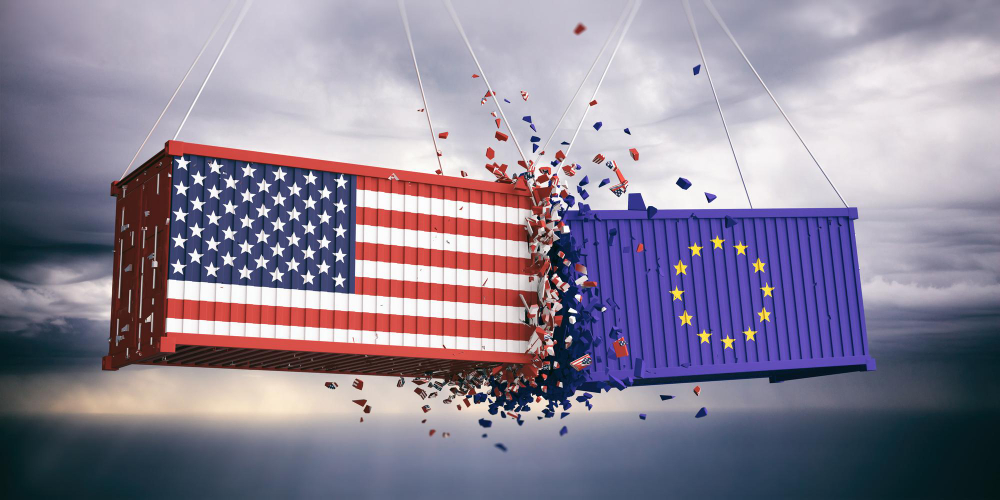

Ursula von der Leyen and Donald Trump have announced a 15% tariff on most EU goods exported to the US. The compromise has avoided a trade war for now—but Europeans need to safeguard the deal’s positive aspects in future trade negotiations.
Problem
Ursula von der Leyen has visited President Donald Trump at his Scottish golf resort to accept a trade deal with the United States that largely acquiesces to Trump’s demands. A 15% tariff on most export goods, and political humiliation, are the price the European Union has to pay for avoiding uncertainty and the short-term pain of a trade war.
The agreement indeed looks like a European capitulation to Trump: the EU has accepted a substantially imbalanced trade framework with America, while seemingly granting US products tariff-free entry in the single market. This will hurt European firms and further reduce Europe’s already sluggish GDP growth, although US importers (and consumers) would likely pay the highest price.
But more significant than the rate itself is that the EU, historically a champion of free and open trade, seems to have accepted such tariffs as the new normal in its trade with America, which is its biggest export market. This calls into question the European commitment to counter Trump’s protectionism via a network of trade agreements with like-minded countries and emerging economies. And, since Trump rarely keeps his word, the stability achieved by the current deal looks precarious at best. America might soon come back with new demands.
Solution
As previous ECFR publications suggest, Europeans should have adopted a much tougher stance against Trump—if they had played their cards more effectively, they might have secured a better deal. This advice should serve as a lesson again now, since the details of the EU-US trade agreement are yet to be hammered out and the tariff status of several types of goods remains unclear.
It is in Europe’s interest to maintain the proposed “zero for zero” tariff on chemicals, aerospace and semiconductor equipment, as well as the lowest possible rate on pharmaceuticals. Europe should now boldly retaliate to discourage the US from unilaterally advancing demands on those categories and maintain a shielded area of low transatlantic tariffs.
The EU’s initial fear of the consequences condemned Europeans to an unfair deal—now credible retribution would help safeguard the agreement’s positive aspects and help them reach more lucrative conditions for the future.
Context
On July 27th, European Commission president von der Leyen agreed with Trump to impose a 15% tariff on most EU exports to the US and 0% on US goods imported to the EU. The agreement aimed to prevent a trade war: America had previously threatened to impose 30% tariffs, which would have led to a retaliatory European package. The 15% rate is largely the result of limited appetite for escalation in European capitals, which opted for unfavourable conditions over the uncertainty of reciprocal retaliations.
However, despite its flaws, the agreement does contain several economic silver linings for Europe. First, the tariff rates that the EU faces in the US are the same as Japan’s and substantially lower than most other countries; a UK-style deal at 10% was never a realistic option due to Europe’s manufacturing exports to America. Second, carmakers—a key European industry—will see the rate drop from the previous 27.5%, providing a welcome breathing space for a struggling sector.
About the author:
Alberto Rizzi is a policy fellow at the European Council on Foreign Relations, based in the Rome office. Previously, he was a pan-European fellow and a visiting fellow with the European Power Programme at ECFR.