
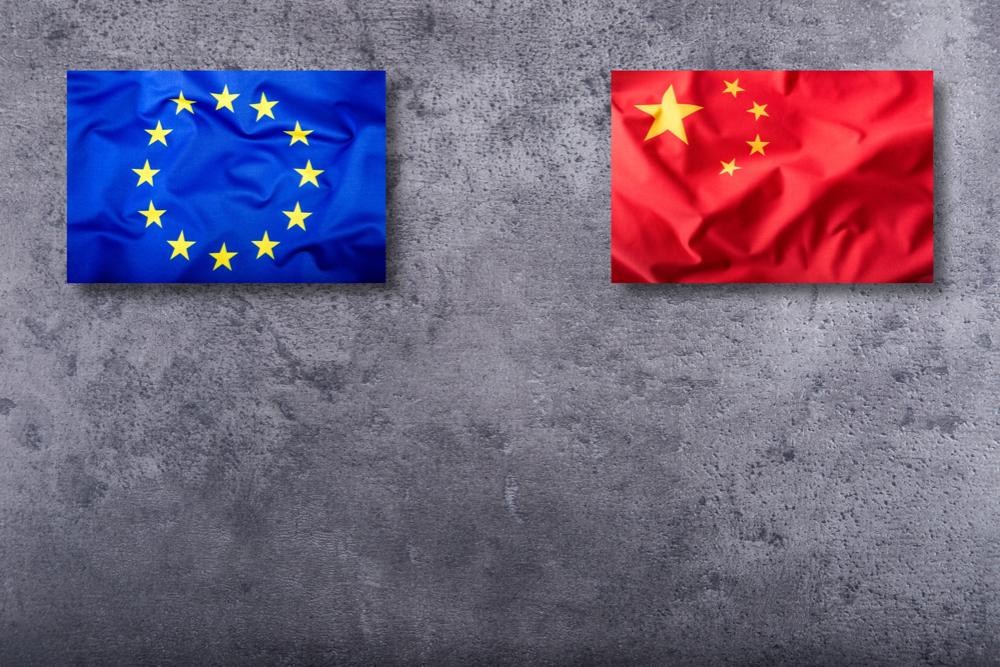

As Europe races to rebuild its industrial base, China is focusing more on influencing international standards and governance frameworks. The two powers are converging because neither can hope to claim a dominant position in the global energy transition by relying wholly on its traditional strengths.
PARIS—For years, Europe and China embodied rival development and energy-transition models. Europe was primarily committed to markets, common rules, and multilateral institutions, whereas China emphasized industrial policy, infrastructure investment, and manufacturing. Europe produced regulations that often became global benchmarks (the “Brussels Effect”). China produced factories.
But this distinction is dissolving. As Europe races to rebuild its industrial base, China is focusing more on influencing international standards and governance frameworks. As European policymakers study Beijing’s industrial strategy, Chinese leaders are realizing what Europe learned long ago: Lasting power comes not only from making technologies, but from writing the rules that govern them.
These trends reflect a change in the composition of geoeconomic power. The decisive question is no longer who controls resources, manufactures products, or leads in each technology. It is who governs the value chains through which the next energy and technological transition will unfold. Far from merely linking factories, those chains also organize finance, logistics, digital infrastructure, standards, and entire industrial ecosystems, forming the frameworks through which economic power is exercised.
Europe’s side of the story is familiar. Confronted with China’s manufacturing dominance in clean-energy technology and its own deepening dependencies, the European Union has rediscovered industrial policy. Its Industrial Accelerator Act, Critical Raw Materials Act, and related measures all follow from the recognition that climate ambition without industrial capacity produces dependency, not resilience.
China’s side of the story has drawn less attention. After two decades of building the world’s largest ecosystem for solar panels, batteries, electric vehicles, and power grids, China has concluded that industrial leadership is not enough, leading it to invest in shaping global rules. The clearest sign of this change is institutional. Through a new Global Energy Interconnection Development and Cooperation Organization, China is convening technical committees to set standards for photovoltaics, hydrogen, energy storage, high-voltage transmission, grid intelligence, and carbon accounting.
These may resemble engineering exercises, but they are much more than that. They represent China’s attempt to own the operating system of the clean-energy economy. The country that sets industry standards does more than regulate a technology. It also puts itself in a position to steer investment, to decide what is interoperable with what, and to lock in the architecture upon which everyone else must build.
Europe has understood this for decades. Its single market was built as much on common rules as on lower tariffs, and European standards routinely became global ones. But European leaders are learning that rules without productive capacity do not provide strategic autonomy, just as China is learning that factories without standards limit international influence. Each is pursuing strategic advantages that the other spent decades perfecting.
But convergence does not necessarily imply symmetry. Each side is reaching beyond its traditional area of strength and therefore encountering new, unfamiliar challenges. Rebuilding an industrial base requires capital, cheap energy, dense supplier networks, and tacit knowledge—none of which can be conjured up through regulation.
Setting global standards is no simpler. A state can staff every technical committee and still fail to get the rest of the world to adopt what it produces. Just as a factory must be built, a standard must achieve widespread acceptance. Neither task is quick or easy. With China and Europe each attempting what it has never had to master before, the outcome remains an open question.
Moreover, the outcome will be influenced by a third major factor: everyone else. Of course, this much larger grouping is not a monolith. A handful of ambitious states—India, Indonesia, Brazil, and various Gulf countries—are building their own industrial capacity and turning critical minerals, growing markets, and patient capital into leverage with which to claim parts of the new value chains. But most countries cannot pursue such strategies. Since they will neither write the standards nor build the factories, they will inherit operating systems designed in Brussels or Beijing, accepting dependencies they never chose.
Then there is the United States, which has opted out of the contest by abandoning the energy transition altogether. Rather than building factories or writing the rules of electrification, it is throwing up tariff walls and abandoning the field to Europe and China.
The stakes are high, because the governance of value chains is as much a political question as a technical one—a small constitution that can quietly allocate advantages and obligations for decades. The traditional approach to industrial policy will therefore have to change. Too often, it is reduced to subsidies, tariffs, and domestic plants. But while the first phase of the clean-energy race was about inventing the technologies, and the second was about producing them at scale, the third will be about governing the chains through which they circulate, connect, and
create value.
For Europe, the lesson is not simply to build more factories. Europe’s real strategic advantage is its proven ability to
turn its own rules into everyone’s rules. It should not take this strength for granted just as it is being contested.
Europe must both continue to craft sound regulations and offer the world standards that are worth adopting, as
opposed to merely enduring.
The energy transition rewards the same rare combination: the capacity to produce, the authority to set rules, and the institutions to hold complex systems together. Neither side can win simply by relying on its traditional strengths.