
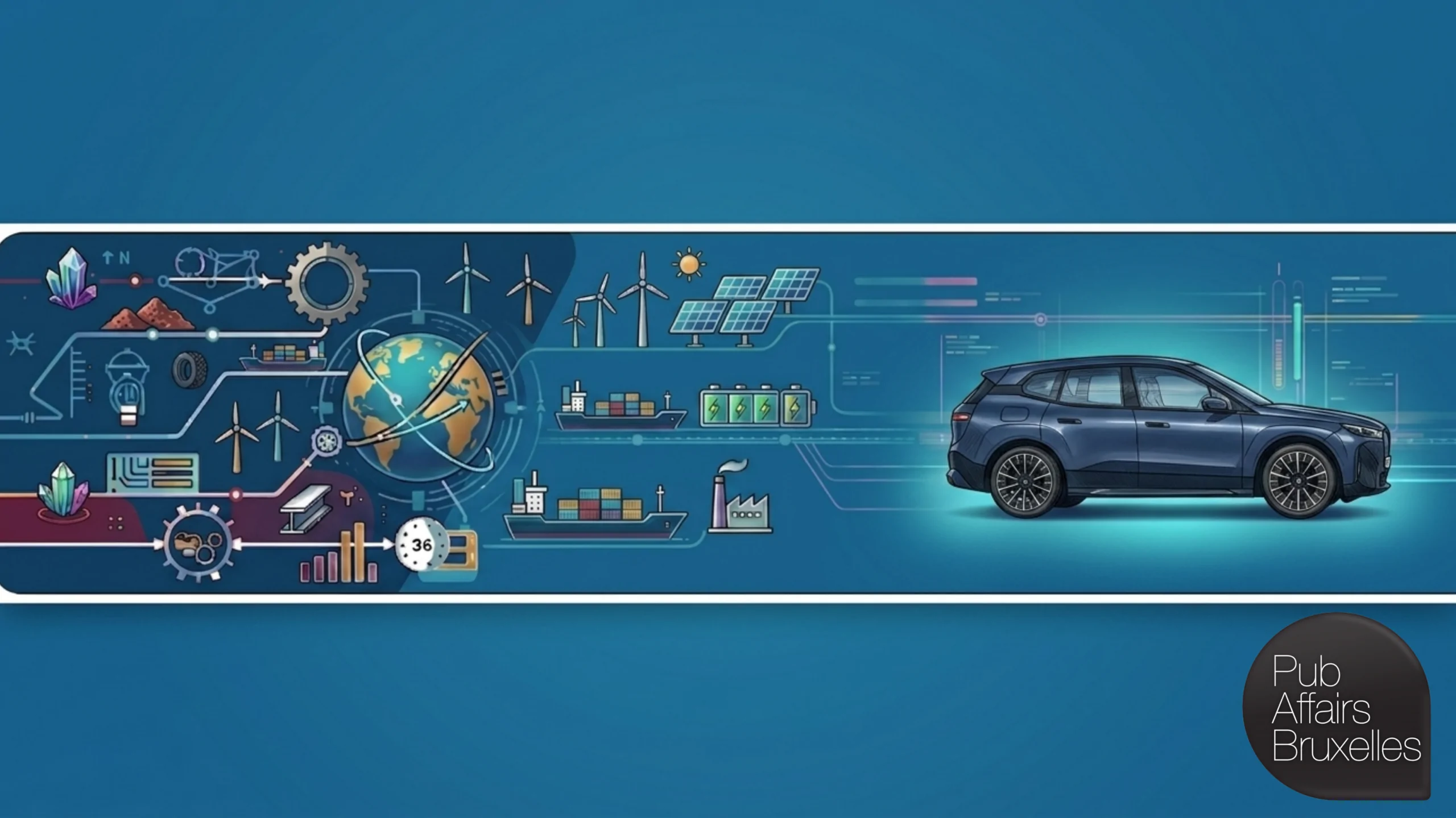
We are delighted to invite you to a hybrid event which will be held on Tuesday, 14th of July at 17.00.
The event will consist of an afternoon of discussion on the industrial, environmental, economic and supply chain challenges reflected in the automotive sector. This event will also be a timely opportunity to discuss how the recently proposed Automotive Package could introduce greater flexibility whilst still allowing the EU to meet its competitiveness and climate objectives, with our distinguished speakers:
- Zala Černilec-Tomašič MEP (EPP/SI);
- Thomas Pellerin-Carlin MEP (S&D/FR);
- Christophe Grudler MEP (Renew Europe/FR);
- Isabel Scheckenbach, Head of Climate Programme, CEPS;
- Frank Niederländer, Vice President Government Affairs Europe, BMW.
Lyubov Pronina, Long-time Brussels Journalist will moderate the event.
This event is public and will be held both onsite and online.
Due to a limited number of seats, please await final confirmation from us after registration.

This event is kindly supported by

About the debate
The European automotive sector is entering a critical juncture as the policy framework underpinning its transition continues to take shape in Brussels. The Automotive Package proposed by the European Commission at the end of 2025 reflects an evolution in the EU’s approach, combining climate ambition with a stronger focus on industrial resilience, as well as on economic feasibility and social acceptance. Currently being discussed in the European Parliament and the Council of the European Union, the package forms part of a broader legislative initiative that is shaping the automotive sector well into the second half of the decade and beyond.
Rather than constituting a single reform, the package brings together a set of interlinked files, including the revision of car emissions standards, demand-side measures to stimulate the uptake of electric vehicles – particularly in corporate fleets – and efforts to streamline regulatory requirements through simplification initiatives. This reflects a broader recalibration of EU policymaking, which seeks to maintain long-term economic and climate objectives, whilst introducing a degree of flexibility to better align with industrial realities and investment cycles.
A central point of discussion is the extent to which the framework should remain open to different technological and temporal pathways. In this context, calls for a more technology-neutral approach to decarbonisation have gained momentum. Experts have also signaled that the current policy architecture places disproportionate emphasis on tailpipe emissions, without sufficiently accounting for lifecycle emissions across the value chain, including raw materials, production processes and energy sources. From this perspective, the debate on how maintaining openness to a range of solutions, alongside electrification, to support innovation, enhance resilience and better reflect the complexity of the transition, is still ongoing.
At the same time, industrial policy considerations are becoming increasingly prominent in the debate. The so-called “Made in Europe” initiative, as an emblematic example, signals a stronger focus on anchoring value creation within the EU, particularly in areas such as battery production, supply chains and manufacturing. While these efforts are widely seen as essential to strengthening Europe’s strategic autonomy and global competitiveness, they also raise questions as to whether such requirements could increase costs for export-oriented industries, potentially slowing domestic industrial transformation and, ultimately, the pace of the transition.
Concerns around competitiveness and investment conditions further underpin the ongoing discussions, as the sector navigates a rapidly evolving global environment characterised by a mix of public support measures, aggressive trade policies and the risk of retaliatory actions from other major economies, all while competition across crucial supply chain segments intensifies.
As institutional discussions progress, it has become evident that striking the right balance between climate ambition, flexibility and industrial policy objectives is not a straightforward exercise. The overall outcome will not only determine the pace and direction of the automotive transition, but also shape the broader role of the sector within Europe’s industrial and technological landscape in the years to come.

This is a public event, hence the Chatham House Rule will not apply.
The event will start at 17.00 both onsite and online, while the onsite welcoming will begin at 16.30. The discussion will last around an hour and a half.
Due to a limited number of seats, please await final confirmation from us after registration, if you wish to attend this event onsite.
The audience will be able to ask questions both in person and through sli.do #IndustrialTransition
We look forward to hosting you on the 14th of July 2026.
